

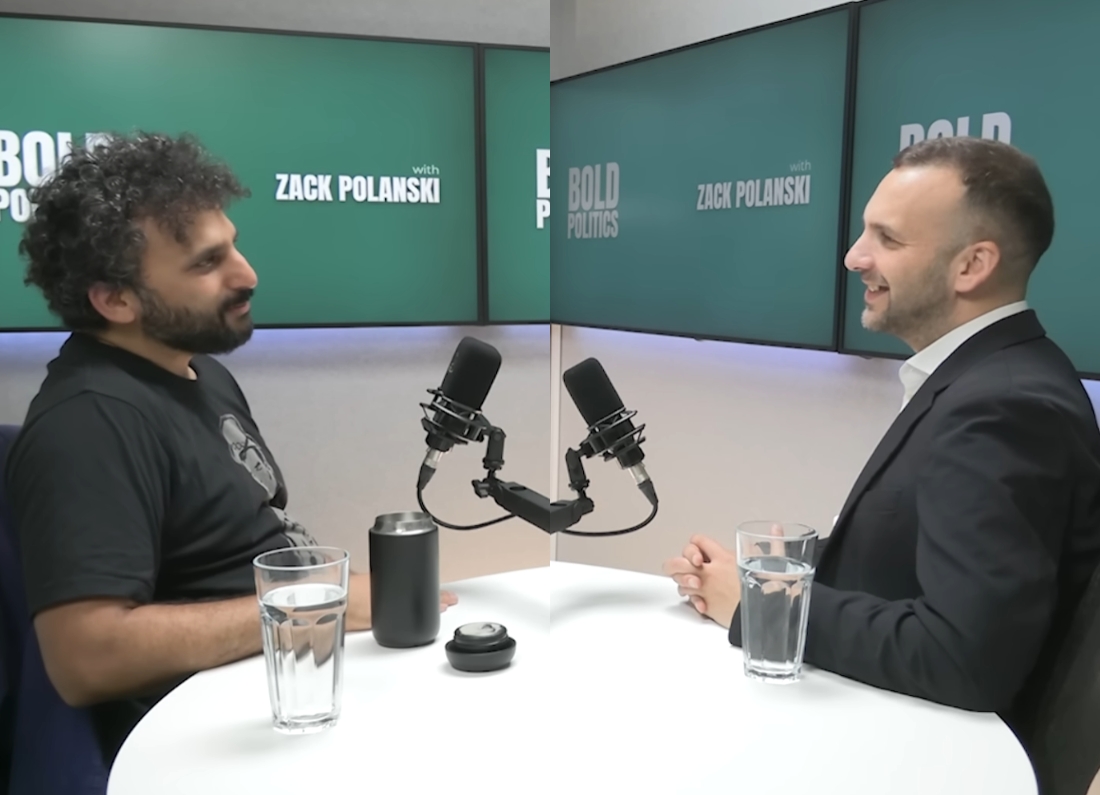
Zack Polanski opened his Bold Politics YouTube conversation with Nish Kumar by noting that, minutes before they started recording, Elon Musk had called him a scumbag and a traitor. Kumar’s response was immediate: “I think sometimes how you receive an insult depends on your level of respect for the insulter. I would think it’s probably a badge of honour to be called that by Elon Musk.”
That exchange set the tone for a wide-ranging conversation touching on social media regulation, Farage’s evasion of scrutiny, political comedy, austerity and fascism, press freedom and the structural conditions that allow the far right to grow. Polanski had been called out by Musk after asking for calm during the Belfast riots, and his reply had been ratioed by three times as many likes.
Social media as publishers
Kumar made the case for regulating social media companies as publishers – a position he has held for years and which the Belfast riots brought back into sharp focus. “These companies have consistently turned around and said ‘we’re not publishers, we’re platforms, we have no editorial oversight’,” he said. “But at the same time, in terms of generating advertising revenue, they very much present themselves as publishers, and they’ve hollowed out our traditional media structures because they’ve essentially replaced those publishers.”
His argument is that the current arrangement gives tech companies all the financial benefits of being publishers with none of the legal responsibility. “When it comes to monetization, they are not particularly very good at sharing the money out. They want all the financial benefit, but none of the actual legal responsibility.”
He was particularly pointed about the role of algorithmic amplification – not just what Musk himself says, but the way the platform is structured to reward divisive and toxic content. “It’s not just the things that Musk is actively saying himself. It’s also the fact that the platform is so slow and unwilling to deal with misinformation, to deal with in some cases AI-generated videos and AI-generated photographs. They should be regulated as publishers.” Press freedom globally is at a 25-year low, and the conversation about who controls public discourse has never been more urgent.
Farage and the £5m
Kumar turned the conversation to Farage’s disappearance from media scrutiny with characteristic directness. “I challenged Farage for a debate four or five times,” Polanski noted. “He just absolutely disappeared off the face of the earth.” Kumar’s response: “Enjoying his 5 million pounds, I think. Allegedly.”
He then made a more substantial point: “If I’d made an allegation that a foreign power had hacked my phone, I’d want some more follow-up questions rather than just dropping that and running. He’s made a very serious allegation that the information about the 5 million was obtained due to information procured by the Russian government hacking his phone. As far as I know, we’ve had no further information about that.” The formal Parliamentary Standards investigation remains live and the FCA has now been asked to investigate his Tether advocacy.
Kumar placed Farage’s media evasion in a Trumpian context, noting that “where possible, do a runner” had become a standard right-wing playbook move – referencing Johnson hiding in a fridge in 2019 and refusing to appear before Andrew Neil. “That is unfortunately a really common tactic that we’re seeing from a lot of these hard-right leaders around the world.”
On Farage’s political significance
Kumar offered what he called an assessment of Farage as “the most consequential politician of my lifetime” – not a compliment but a recognition of structural impact. “Without actually holding ministerial position, he has essentially been able to conduct the Conservative Party’s business for most of the 21st century.” The electoral threat posed by UKIP and then Brexit Party forced successive Conservative leaders to chase Farage rightward until Cameron called a referendum he didn’t need to call and couldn’t win.
But Kumar also identified what he sees as a new vulnerability in Farage’s position. “For the first time in a long, long time, Farage doesn’t look like he knows his role. He isn’t the tail wagging the dog. He now is the dog. And he’s now being wagged by the Elon Musk-backed Restore Party led by Rupert Lowe.” Internal Reform splits after Makerfield and the party’s fading post-election bounce both support that reading.
The conditions for fascism
The conversation ended on the most substantive ground – the structural conditions that allow the far right to thrive. Kumar’s argument was direct: “The far right really can only thrive in conditions of economic hardship and spiraling inflation. That tends to be a gateway that the far right walks into, and that’s happened over and over again.”
He made a point that connected back to what economist Clara Mattei has been arguing in detail: that the political right in this country has consistently identified the real causes of economic misery while misdirecting blame onto immigrants and minorities. “You can keep deporting us and keep deporting us and it ain’t going to help you. You can deport us until there’s none of us left and I promise you, Elon Musk is still going to have a disproportionate control of the capital in your country. That’s not fixing the real cause. It’s scapegoating and it distracts you from actually making improvements to people’s lives.”
He noted that cartoons of Polanski during the last byelection had echoes of 1930s antisemitic imagery, and was blunt about what that meant: “I saw the ghosts of it in stuff that was being drawn pertaining directly to you about a month ago. I was shocked. We want to talk about World War II in terms of types of tanks or RAF planes. Let’s talk about the actual conditions through which extremism took hold in a Western European country. And when we say never again, we mean never again.”
The YouTube comments reflected the energy of the conversation. “When the richest parasite on the planet calls you a scumbag and a traitor, it’s an amazing indicator that you’re doing something very, very right,” wrote one viewer. Another: “I feel like we need to make ‘Called a scumbag by Elon Musk’ the new ‘Hated by the Daily Mail’.”
You can watch the full interview below:






Leave a Reply