

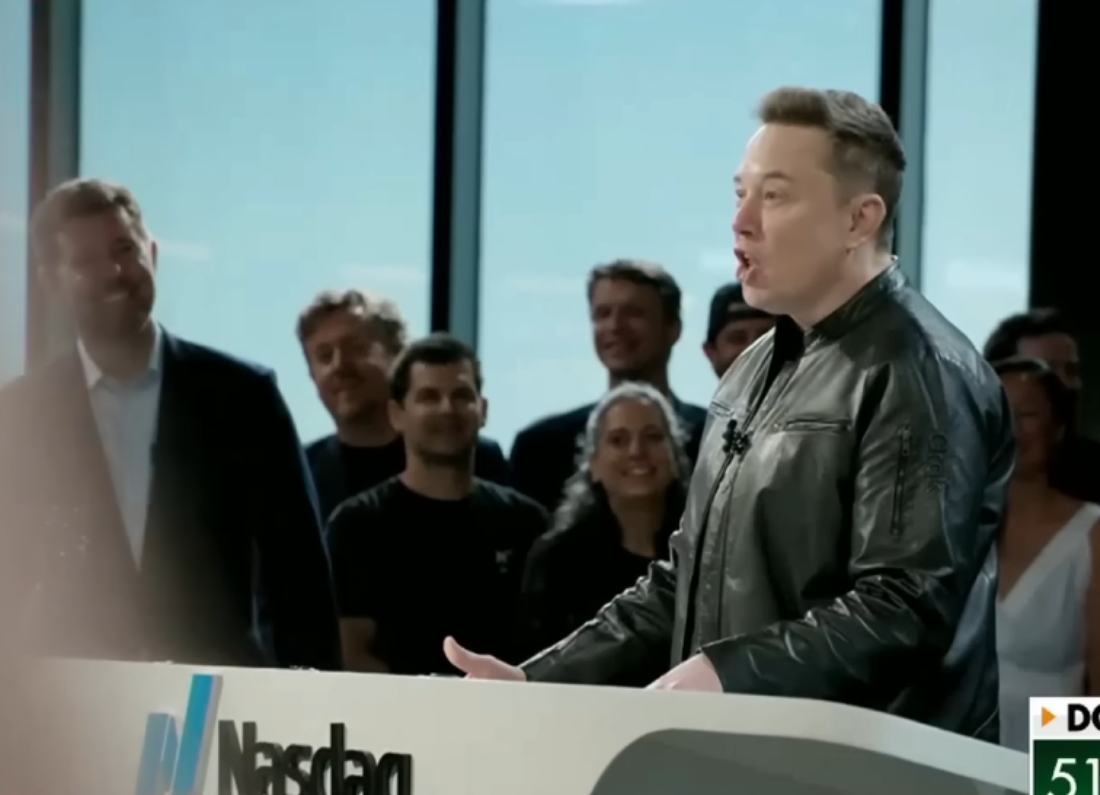
Elon Musk has become the world’s first trillionaire following the SpaceX IPO, which raised $75 billion in the largest public offering in history. He is now richer than the four billion poorest people on the planet combined. His wealth grew by $550 billion in the last twelve months – more than $1 million a minute. The cost of ending extreme poverty for one year is approximately $96 billion. He could do it ten times over. Oxfam has called his trillionaire status “a dark day for democracy.” Musk has not responded to the poverty comparison.
The numbers
The figures, drawn from World Bank, Forbes and Oxfam data, require a moment to sit with.
Musk is richer than 46% of the world’s population combined. That is approximately four billion people. His net worth increased by $550 billion in a single year – a pace of wealth accumulation that works out at more than $1 million every sixty seconds, around the clock.
If Musk were to spend $1 million every day from now, it would take him approximately 2,750 years to exhaust his estimated net worth. If he were to hand every person on earth a $100 note, he would remain one of the ten wealthiest individuals on the planet, with $184 billion remaining.
The comparison Oxfam has foregrounded is the most pointed: the annual cost of lifting every person currently living in extreme poverty above the poverty line is approximately $96.2 billion. Musk’s fortune could fund that intervention more than ten times over. A 10% tax on his wealth alone, Oxfam calculates, could lift 800 million people above the extreme poverty line.
He has not done this.
How he got here
The source material notes, with some precision, that Musk is “born into massive wealth and supported by an estimated $38 billion of the US Government’s money” – a figure from Washington Post research tracking the government contracts and subsidies received by his companies. The SpaceX IPO, which took the company public at a valuation that produced the largest IPO in history, completed the transformation from multi-billionaire to trillionaire.
This is the same SpaceX whose IPO was accompanied, on its eve, by the appearance of a giant topless inflatable Musk in Times Square covered in tattoos referencing Grok’s AI child imagery scandal – as we reported in our inflatable Musk piece. The coincidence of the protest and the IPO was not accidental. SpaceX’s valuation was built on government contracts from the same administration in which Musk took a senior position, which he later left after what was described as an acrimonious split with Trump.
Oxfam’s response
Nabil Ahmed, Senior Director of Economic Justice at Oxfam America, was unambiguous. “Elon Musk’s rise to trillionaire status marks a new pinnacle of oligarchy and a dark day for democracy. He is a government-backed trillionaire whose fortune was fuelled by regressive public policy choices, and decisions rigged by a tiny few to fuel their own fortunes.”
Ahmed continued: “A trillion dollars in the hands of one man is incompatible not only with an affordable economy, but also with a healthy democracy. Economic inequality begets political inequality, and ordinary people bear the brunt while billionaires continue to write the rules for their own benefit.”
As we reported in our Zucman wealth tax piece, economist Gabriel Zucman’s research shows that billionaires pay roughly half the effective tax rate of workers – a consequence of structuring income to avoid standard tax obligations. The UK’s top 200 families went from owning 5% of GDP in 1989 to 25% today. The global picture that Musk’s trillionaire status sits within is one of accelerating wealth concentration – and its political consequences.
The political dimension
Ahmed’s description of Musk as a “government-backed trillionaire” is specific. SpaceX has received tens of billions in federal contracts. Tesla received significant subsidies through electric vehicle tax incentives. The accumulation of wealth at this scale has not happened independently of the state – it has happened, in significant part, through the state.
This is also the same Elon Musk who, as we reported in our Hasan Musk piece, Mehdi Hasan described as using X to pursue “a very racist agenda” – amplifying far-right voices across Germany, Britain and the United States, funding the AfD with $100 million and sharing Belfast riot protest locations with his 240 million followers. As we reported in our Polanski Musk piece, he called Green Party leader Zack Polanski “a scumbag and a traitor” for asking for calm.
As we reported in our Mehdi Hasan News Agents USA piece, Hasan drew the specific comparison with how Orbán, Erdoğan and Modi consolidated power: not through tanks, but through billionaire friends buying media. “What is the point of having your money if you never say f*** you?” Hasan asked, of Jeff Bezos’s capitulation to Trump. The same question applies in reverse to Musk – who has the money and is using it.
Ahmed’s formulation – “Economic inequality begets political inequality” – is the connecting thread. A trillion dollars in one person’s hands is not just a question of poverty statistics. It is a question of whose hands are writing the rules.
What could be done
Oxfam’s proposed solution is not confiscation: it is a 10% tax on Musk’s wealth that would raise approximately $100 billion and could, on their calculations, end extreme poverty. This is the same Zucman-adjacent territory we covered in our wealth tax piece – where Zucman’s research showed that 7 Nobel Prize winners back a 2% global wealth tax on assets over $100 million, which would raise $15 billion in the UK alone from approximately 1,000 families.
Musk’s trillion-dollar fortune represents a different order of magnitude. A 10% levy would leave him with $900 billion. He would still be the wealthiest person in recorded history by a significant margin. He would also have ended extreme poverty for the year.



Leave a Reply