

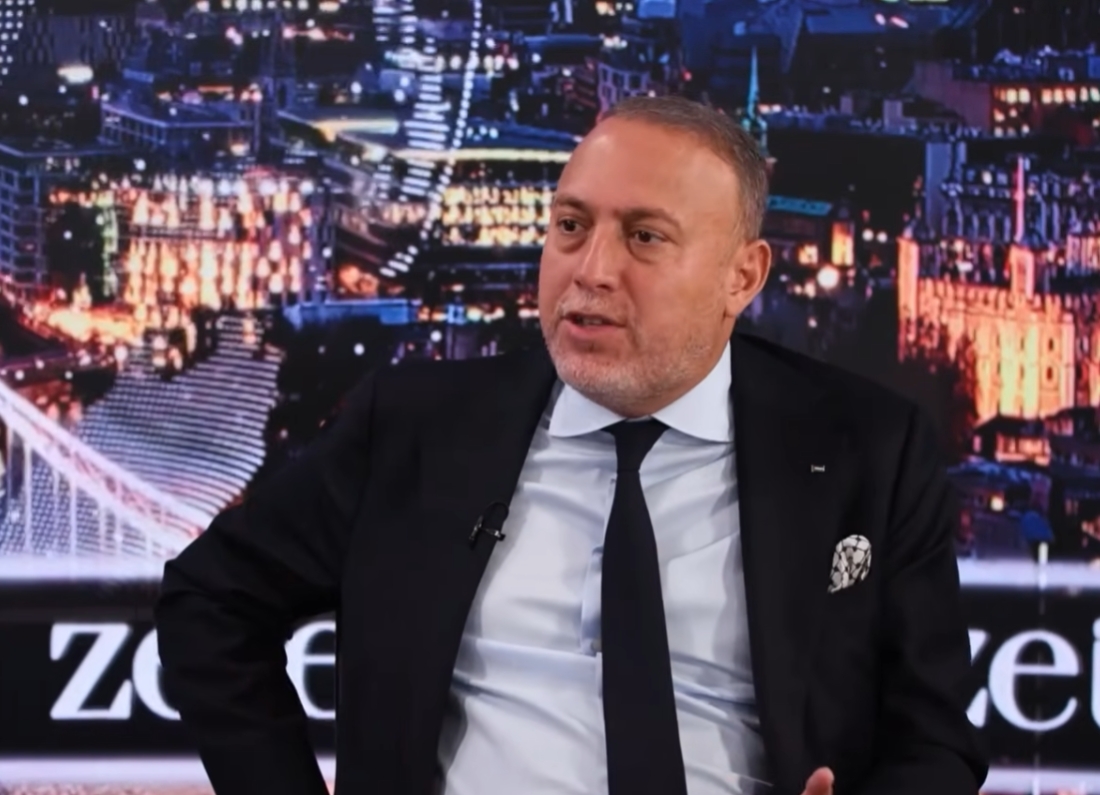
Palestine’s ambassador to the UK has said British ministers have told him a “much tighter” regime for arms exports to Israel is coming.
Husam Zomlot said he had heard directly from Foreign Secretary Ed Miliband, other Foreign Office ministers and international counterparts about plans for further restrictions.
Speaking to Zeteo UK’s political editor Shehab Khan, Zomlot said:
“I’ve heard directly from the foreign secretary and from the ministers in the Foreign Office, and from several counterparts, that there will be a new regime for the arms trade, much tighter. Much tighter.”
Asked whether he expected changes soon, Zomlot said discussions were continuing but declined to reveal everything he had been told.
“I’ve heard much more and I’m not going to share it here,” he said.
The UK government has not publicly announced a new arms export regime matching Zomlot’s description.
His comments therefore offer a potentially important glimpse at discussions taking place behind closed doors as Andy Burnham’s government takes a tougher line towards Israel over Gaza and the occupied West Bank.
UK has already suspended some arms licences
Britain has already restricted some military exports to Israel.
In September 2024, the government suspended around 30 arms export licences after concluding there was a “clear risk” that certain equipment might be used to commit or facilitate serious violations of international humanitarian law in Gaza.
The restrictions covered equipment including components for military aircraft, helicopters and drones, as well as items used for ground targeting.
They did not amount to a full arms embargo.
Exports connected to the multinational F-35 programme were also largely excluded where components entered the global supply chain rather than being sent directly to Israel.
Government data published this year showed 395 non-suspended licences involving Israel remained in place as of February 28, 2026.
That figure included military and non-military goods, as well as licences connected to the F-35 programme.
Of those, 17 military licences covered equipment for the Israeli government which ministers said was either not usable in military operations in Gaza or otherwise exempt from the suspension.
Zomlot wants Britain to go considerably further.
“The settlements is the crime but Israel is the criminal,” he told Khan.
“So you cannot sanction the crime without sanctioning the criminal. And we need to look into the issue of arms trade.”
Burnham government has already hardened policy on settlements
The interview came after the government announced a package of measures targeting Israeli settlements in the occupied West Bank.
On September 8, Foreign Secretary Ed Miliband announced plans to ban imports of goods from settlements considered illegal under international law and introduce sanctions against people and companies supporting, facilitating or benefiting from settlement activity.
Britain joined Canada, Denmark, Finland, France, Iceland, Ireland, Norway, Poland, Portugal, Spain and Sweden in announcing or considering restrictions on settlement trade.
The joint statement cited rising settler violence and continued settlement expansion, including Israel’s E1 project.
Prime Minister Andy Burnham has since repeated the government’s opposition to E1 at the United Nations and said Britain had acted by banning trade with illegal settlements, sanctioning those involved and formally recognising the Israeli occupation of Palestinian territory as unlawful.
Zomlot described the change as a “turning point” in relations between Britain and Palestine.
He also praised Miliband’s approach and contrasted the new government with Keir Starmer’s administration.
Zomlot credited Starmer with recognising Palestine but told Zeteo there was a difference in how he viewed the motivations of the two governments.
He said Starmer had eventually recognised Palestine because of public, parliamentary and political pressure.
“What is different now with Prime Minister Burnham and Foreign Secretary Ed Miliband is that I feel that they want to do it,” Zomlot said.
“It’s about the belief. It’s about the moral compass. And this is very encouraging.”
That is Zomlot’s assessment of the two administrations rather than an independently established account of their motivations.
Israel has hit back at Britain’s measures
The tougher British approach has already produced a diplomatic confrontation with Israel.
Israel announced plans to close the British consulate in Jerusalem following the UK measures against settlement trade.
Britain does not recognise Israeli sovereignty over East Jerusalem, which the UK regards as occupied Palestinian territory.
Former attorney general Dominic Grieve has since advised the Foreign Office that Israel does not have the legal right to close the consulate, according to The Guardian.
Zomlot dismissed Israel’s decision as legally invalid.
“Jerusalem, East Jerusalem is an occupied city,” he said.
“Israel has no sovereignty or validity of any decision of such sort. So the decision legally is null and void.”
The Israeli government rejects a number of the legal and political characterisations used by Palestinian representatives and has strongly criticised international sanctions targeting settlements.
‘This is a beginning, not an end’
Zomlot repeatedly described Britain’s new measures as the start of a wider campaign rather than the finished policy.
“This is a beginning, not an end,” he said. “This is a foundation on which we can build.”
He wants sanctions expanded beyond individual settlers and settlement-linked businesses and ultimately wants greater international pressure on the Israeli state.
Zomlot compared the approach he wants to see with the gradual international isolation of apartheid South Africa.
He also said Britain carried a particular responsibility because of its historic role in Palestine and its position within the international diplomatic system.
The ambassador stopped short of backing one area where Britain has so far stayed out.
Asked repeatedly whether he wanted the UK to join the US-backed Board of Peace overseeing Gaza, Zomlot declined to call for British membership.
He instead said Britain should continue following international law and focus on ending the war.
When Khan pressed him again, Zomlot replied: “That’s for the UK to decide, not for me.”
Zomlot speaks about family members killed in Gaza
The interview also became deeply personal.
Zomlot, who was born in Rafah and previously served as the Palestinian representative in Washington, spoke about relatives, friends and places from his childhood which he said had been lost during the war.
He told Khan he had lost “tens” of members of his wider family and described the difficulty of continuing his diplomatic work while dealing with grief.
“It’s very difficult,” he said.
“The people I’m talking to you about are people I grew up with. They are my memory, and not just family but friends, classmates, neighbours.”
He said Rafah, where he was born, had been devastated and described grieving for places from his childhood as well as people.
Zomlot said he was deliberately postponing fully processing that grief while the conflict continued.
“You have to suppress your feelings all the time so you can wake up in the morning, have hope, because if you lose hope, we’re finished.”
The war and its conduct remain fiercely disputed.
Israel says its military operations have targeted Hamas following the October 7 attacks and accuses the group of operating from civilian areas. Zomlot rejected that argument during the interview and accused Israel of deliberately targeting Palestinian civilians.
Britain continues to condemn Hamas and the October 7 attacks while also sharply criticising the Israeli government’s conduct in Gaza and the West Bank.
Burnham told the UN last week that Hamas’s attack was “utterly horrific” but said it did not justify the Israeli government’s actions, citing civilian deaths, restrictions on aid and settlement expansion.
For the UK government, the next question is whether its tougher approach to settlements will now be followed by another change on arms exports.
Zomlot says he has already been told it will.
Ministers have yet to say publicly what that might look like.




Leave a Reply