

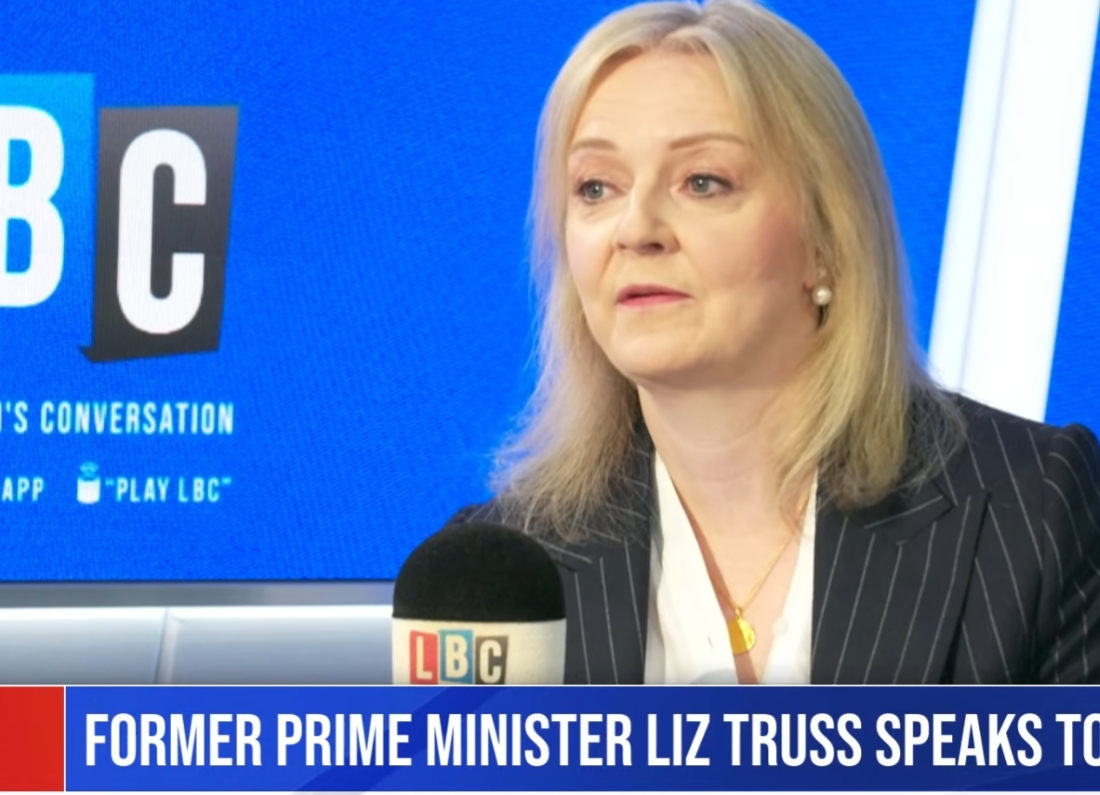
Liz Truss has prompted a wave of reaction online after appearing to say that the Bank of England was set up by Tony Blair.
There is just one fairly substantial problem with that statement.
The Bank of England was founded in 1694.
The former prime minister made the comment during an interview with LBC’s Nick Ferrari while arguing that Britain should dismantle what she described as “Blairite institutions” and reverse changes made to the Bank during Labour’s first term in government.
Truss told Ferrari: “The Bank of England was set up by Tony Blair.”
According to footage of the exchange, Ferrari then questioned what she had said, giving Truss an opportunity to clarify her wording.
She repeated the claim.
Predictably, that particular moment quickly began travelling around social media.
But there is also some important context.
Tony Blair’s government clearly did not establish the Bank of England. What it did do was fundamentally change how the Bank operated by granting it operational independence over monetary policy in 1997.
That distinction is important, particularly because reversing those reforms appears to be what Truss was actually arguing for during the interview.
The Bank of England was founded in 1694
There isn’t much ambiguity about the Bank’s actual age.
The Bank of England says it was formally established by Royal Charter on July 27, 1694, during the reign of William III and Mary II.
It was originally created to raise money for the government during war with France and began life as a privately owned bank.
More than 1,200 people subscribed to its original £1.2 million capital issue.
The Bank was later nationalised by Clement Attlee’s Labour government in 1946, placing it into public ownership.
Tony Blair would not become prime minister until more than 300 years after its creation.
So what was Truss talking about?
What Tony Blair’s government actually changed
The answer almost certainly lies in one of the most significant economic reforms of the Blair years.
Just days after Labour won the 1997 general election, Chancellor Gordon Brown announced that the Bank of England would be given operational independence over monetary policy.
That meant politicians would no longer directly decide the level of interest rates.
Instead, the Bank’s Monetary Policy Committee would make those decisions independently while pursuing an inflation target set by the government.
The change took effect on May 6, 1997 and was subsequently put onto a statutory footing through the Bank of England Act 1998.
Even the Bank itself describes the changes as a watershed moment in its development.
It was a major transformation of the institution.
It was not, however, its creation.
Truss wants the Bank of England Act scrapped
That context matters because Truss was not discussing the history of central banking out of nowhere.
She was making a political argument about how much power institutions such as the Bank should possess.
During the LBC interview, Truss called for the Bank of England Act to be scrapped and argued that the central bank had become too powerful.
She described the institution as “unaccountable and unsackable” and said Britain needed to get rid of what she regarded as institutions created or empowered during the Blair era.
Truss has also continued to challenge the conventional account of the turmoil surrounding her short-lived premiership in 2022.
Her government unveiled a major package of tax cuts under then-chancellor Kwasi Kwarteng, after which government borrowing costs surged and the Bank of England intervened in the gilt market.
Truss has repeatedly argued that Britain’s economic establishment and powerful institutions frustrated the programme she was attempting to implement.
Her latest comments appear to form part of the same argument.
But it was the wording she chose about the Bank’s history that inevitably grabbed attention.
The internet noticed
Once the clip began spreading, social media users wasted little time pointing out the sizeable gap between 1694 and Tony Blair’s arrival in Downing Street.
@Tush27J wrote:
” Liz Truss.
“The Bank of England was set up by Tony Blair.”
🤣🤣🤣🤣🤣🤣🤣🤣🤣🤣🤣🤣🤣🤣🤣🤣🤣🤣🤣🤣🤣🤣🤣🤣🤣🤣🤣🤣🤣🤣🤣🤣🤣🤣🤣🤣🤣🤣🤣🤣🤣🤣🤣🤣
Bonkers, absolutely bonkers.”
@SheldonMiller joked:
“So that makes Tony Blair over 332-yrs-old.”
@LilywhiteSimon simply wrote:
“It was definitely him!”
@ChrisO_wiki added:
“It would have been nice if she’d known when the Bank of England was created before becoming First Lord of the Treasury or, indeed, after”
@ruth_wishart wrote:
“Even more doolally than before.”
@AdrianWait55 added:
“She is as Mad as a box of Frogs….”
Not everybody agreed with the interpretation of the clip.
@fad56 defended Truss, writing:
“It’s independence.
You know full well that’s what she’s talking about”
But @bmay responded:
“Nope. He asks, and she again says it”
And @Angelsfeartogo concluded with perhaps the most predictable callback to Truss’s premiership:
“Lettuce pray she disappears from politics”
Was Truss simply talking about independence?
That is where the exchange becomes slightly more interesting than the viral clip alone suggests.
Taken completely literally, the claim that Tony Blair “set up” the Bank of England is straightforwardly incorrect.
The Bank had already existed for more than three centuries.
But the surrounding conversation strongly indicates that Truss was talking about the system established after Labour entered office in 1997.
And she has a point in one narrow respect: Blair’s government did oversee a fundamental reorganisation of the relationship between the Bank and elected politicians.
The decision to give the Bank operational independence over interest rates was announced by Gordon Brown almost immediately after Labour took power.
The Bank itself says it has had monetary policy independence since May 1997.
So describing the modern independent Bank as a creation of the Blair era would at least capture part of what changed.
Saying Blair “set up the Bank of England” is something rather different.
A genuine political argument buried underneath a viral moment
There is also a serious policy argument beneath the social media jokes.
Central bank independence is intended to insulate decisions on interest rates from short-term political pressure.
The government still sets the inflation target, currently 2 per cent, but the Bank decides how interest rates should be used to meet it.
Truss believes that arrangement gives too much influence to unelected institutions.
Critics of her position argue that giving governments direct control over monetary policy risks allowing political considerations to influence decisions which can have enormous consequences for inflation and the wider economy.
That debate is legitimate and is likely to continue.
And if Truss succeeds in pushing the role of the Bank back into political discussion, her LBC appearance may end up receiving attention for more than one line.
For now, however, the history remains rather simpler.
Tony Blair’s government transformed the Bank of England’s independence.
It did not establish the Bank of England.
For that, you have to go back to 1694.




Leave a Reply