

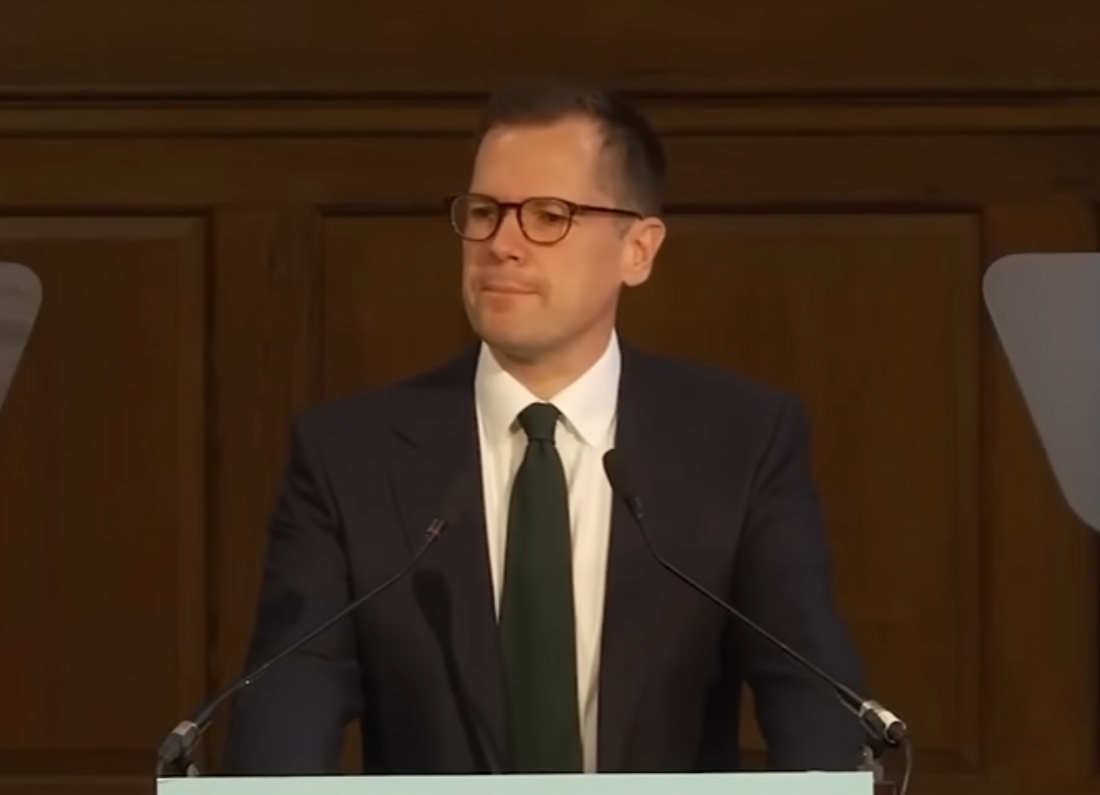
Robert Jenrick faced reporters in Westminster on Wednesday, following Andy Burnham’s speech on social care. Most of the questions weren’t about social care.
The Cottrell question, and the non-answer
A reporter opened with the Guardian’s story from that morning: George Cottrell gave his mother more than $2m shortly before she donated to Reform. Was there an internal investigation? Was Jenrick confident the money came from permissible donors?
“Look, the donations you’re referring to were some time ago,” Jenrick said. “This has been going on for a long time. But we are entirely confident that Reform followed all electoral rules at the time when the donations were made. Of course, we’ll participate with any inquiries. As to the best of my knowledge, we haven’t even been contacted by the police. So I don’t think we have anything more to add to that.”
Then he tried to move on: “I presume you don’t have a question about the actual substance of the press conference today. No. Okay. Well, it would have been better to ask that one first. But if you want to actually ask about the issues that the public care about, then by all means.”
When pressed again on Cottrell specifically
The reporter came back to it directly: what explains George Cottrell transferring $2m to his mother shortly before her donations to Reform?
“Well, firstly, on the donation, as I said earlier, Reform is certain that all the electoral rules were followed. If you’ve got a question for Mr Cottrell, then I think you have to direct that to him.”
Told he was the one being asked, and being asked to answer, Jenrick pivoted straight to social care tax policy instead.
On funding social care
Asked whether he’d consider any kind of levy to fund social care, even a thresholded one, Jenrick was flat: “No. Look, if I was the Chancellor faced with this challenge, I would not tax hardworking people a single penny when we had not yet stopped paying for a NATO rich countries, stopped the net zero madness that’s costing us tens of billions of pounds, stopped paying benefits to people who are not even British citizens, stopped the small boats crisis, which is costing us billion pounds in hotels and bedsits the length and breadth of the country, cut out the waste, use that money to support British people with their challenges including social care. Get that job done before you start reaching into the pockets and the life savings of the best people in this country who’ve worked hard their whole lives, built up a small nest egg, and just want to be able to hand that on to their children and their grandchildren. That’s my message to Andy Burnham today.”
He then went after Burnham specifically over inheritance tax: “He’s proposed the death tax in the past. In fact, he’s been proposing this for nigh on 20 years. If he no longer supports it, rule it out. He’s ruled out other tax increases in recent days. He was conspicuously absent in ruling this out at his press conference this week. We’re calling on him today, rule out the death tax, end the uncertainty, enable families to move forward with their lives without the worry and the angst that will follow. And the difference between this and the present situation is very clear. This is universal. Absolutely everyone in this country, from the poorest person to the richest in the land, will have to pay that. I think that’s unfair, it’s cruel, and Reform are going to campaign against it.”
Back to Cottrell, a third time
LBC’s Bethany Dawson pushed on the same question again. Jenrick insisted he’d already answered it: “I did answer it. I said that we followed all of the rules.”
The ‘kangaroo court’ line
Dawson’s second question moved to Farage’s byelection and the parliamentary standards process. A Reform colleague had reportedly called it a “kangaroo court.” Would Jenrick use that language too?
“Well, I think I did use it. You may actually be referring to me,” he said, before defending the framing at length: “Look, I’m not here to cast aspersions on the standards commissioner or the officials that work with him. The point that I made in the past is that all the other political party leaders have already prejudged the issue. Kemi Badenoch has said that she will stand a candidate in the next by-election. Well, what is the next by-election? The by-election after Nigel Farage has been found guilty? That’s the point here. It is not for Kemi Badenoch, Andy Burnham, Ed Davey, Zack Polanski, or any other politician to play judge, jury, and executioner of Nigel Farage. At the end of the day, we live in a democracy. It’s for the people to determine. If the people of Clacton get behind Nigel with knowledge of all of the facts and say, ‘We want this man to be our member of Parliament,’ then let that be the determiner of who represents the people of Clacton in the House of Commons. That’s the point of this by-election. It is the people versus the establishment.”
He said he’d visited Clacton “a number of times” and had “every confidence that the people of Clacton are going to support Nigel every step of the way.”
Reform’s pitch on who it actually represents
Jenrick used the moment to lay out Reform’s positioning more broadly: “The way I see reform is this. The Labour Party is for Benefit Street. The Tory Party is for Belgravia. Reform exists for the 80% in the middle. The hard-working, decent people of this country, the workers and the people who worked their whole lives and are now retired just simply want dignity and security in the last decades of their lives. So our policies will be for them. Our policies will not be for benefits street, nor will they be for the richest in the land.”
He listed specific policies: no tax on overtime, scrapping what he called “Rachel Reeves’s job-destroying increase in employer’s national insurance,” and keeping the pensions triple lock. “That gives you a sense of what a Reform government would do. Always for the 80% in the middle, never for benefits street, and not for Belgravia either.”
Palantir, procurement, and Cottrell one more time
Bloomberg’s Teddy Stoddart raised two separate points: Jenrick had specifically name-checked Palantir earlier in his remarks as a valid provider of NHS patient records software, despite clinicians pointing to homegrown alternatives like Cypher. And, again, was Reform confident it knows the actual source of George Cottrell’s wealth?
On Cottrell: “I don’t think there’s anything more to add. I’ve already said that we’ve followed all the electoral rules and we’re very confident of that.”
On procurement, Jenrick set out a broader position: “A Reform government is always going to put British people first. It’s always going to put British businesses first. So one of the changes that I would make as Chancellor is to rewrite our procurement rules so that we scrap all of the nonsense that has been ladled into them over recent times, like David Cameron’s social value test that said things like people getting contracts off the government need to provide foreign languages or diverse workforce plans, and simply go for best value for money for the taxpayer and can it be provided by British company. So yes, we do have a preference for British businesses.”
He then defended Palantir specifically, and cast doubt on the motives of those questioning it: “It seems very odd to me that somebody who’s posing as being concerned to just get their hands dirty and fix problems for the benefit of patients would be considering scrapping a technology that demonstrably is working to reduce waiting lists and to get people out of hospital swiftly and into care homes or back home to their own home and improve the quality of treatment in the system. And I suspect the motivation is not AI sovereignty or British companies getting the contracts, but it’s because there’s some people on the hard left who don’t like a company that happens to provide a bit of tech to Israel or the United States getting contracts. In Reform, we have a preference for British businesses, but we’re never going to put mad hard left ideology above making sure the NHS actually functions properly and we help patients.”
Where that leaves things
Three separate reporters asked about the $2m transfer to Fiona Cottrell across the press conference. Jenrick gave the same answer each time: entirely confident the rules were followed, no contact from police, nothing further to add. Nothing about the specific timing, nothing about why the money moved 24 to 72 hours before each donation, nothing addressing the pattern itself.
What he did offer, at length, was a defence of the standards process being unfair to Farage before it’s even concluded, alongside a fairly detailed account of Reform’s tax and procurement positions. Whether that’s a coincidence of a busy press conference or a deliberate strategy for handling the Cottrell questions is something Reform will keep being asked about as the Met’s investigation continues.







Leave a Reply