

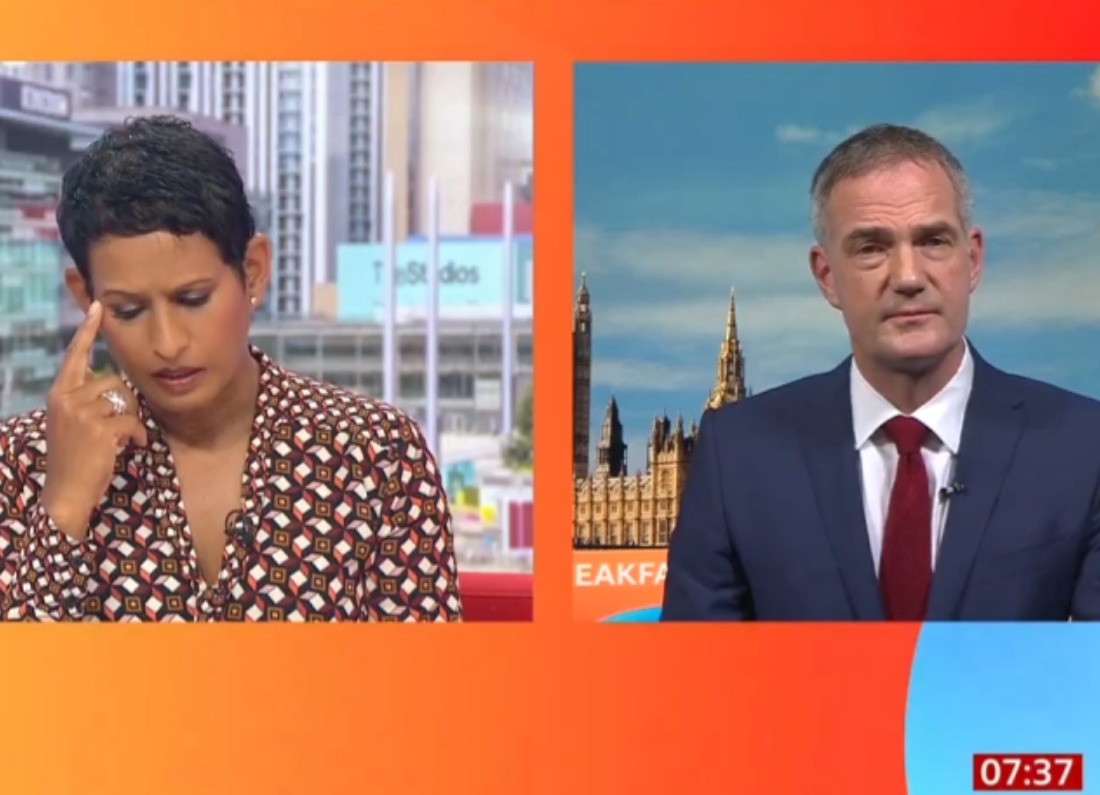
Business Secretary Peter Kyle was sent out on Friday morning to defend the Government’s Defence Investment Plan on BBC Breakfast. It was, from the outset, an unenviable task. John Healey had resigned as Defence Secretary two days earlier. Armed Forces Minister Al Carns had followed him out the door hours later. Both had gone because they had seen enough of the plan to conclude it was inadequate. Kyle’s job was to explain why they were wrong.
The interview was going reasonably well until Naga Munchetty asked whether he had actually seen the plan he was defending. Kyle said no. She asked how he could know it was good if he hadn’t seen it. He said: “Because I have faith in a PM… to fund the plan and design a plan and lead a plan, of course, and he is the PM that is fit for the moment we’re in.” Munchetty’s face said the rest.
The interview – and where it fell apart
Kyle was doing what Cabinet ministers do when sent to defend a policy under pressure: he talked up the Government’s approach, emphasised the Prime Minister’s leadership, and indicated that when the plan was published, people would see Starmer had got it right.
It was a standard ministerial holding position. It would have been unremarkable in a normal week.
This was not a normal week.
As we reported in our Healey resignation piece, Healey’s letter accused Starmer and Reeves of being “unable and unwilling” to commit the resources needed to defend the country, revealed the plan would raise defence spending by just 0.08 of a percentage point of GDP by 2030, and made clear he had only been told the final figures on Monday. Carns, as we reported in our Tice GB News piece, described “a failure of seriousness” at the heart of the budget and said Number 10 would not listen.
Into this situation walked Kyle, sent to the BBC Breakfast sofa to reassure the country. Munchetty pressed him on his confidence. He talked up the plan. She asked the question that followed naturally from everything he had said.
Had he seen the plan?
Kyle said no.
Munchetty’s follow-up did not need to be aggressive. It simply had to be the question most people watching at home were already asking. How do you know it is good if you have not seen it?
“Because I have faith in a PM… to fund the plan and design a plan and lead a plan, of course, and he is the PM that is fit for the moment we’re in.”
Why the answer was so damaging
Kyle’s response was not irrational. Cabinet ministers regularly defend policies outside their own department. They are often sent into studios with instructions to hold a line before a document is formally published, to defend the Prime Minister and avoid getting dragged into details that have not yet been confirmed.
But the specific structure of this situation made the faith argument uniquely difficult to sustain.
The Defence Investment Plan did not exist in a vacuum. It existed in the context of two defence ministers who had both resigned because they had seen it – or seen enough of where it was heading – and concluded it was inadequate. Healey’s specific charge was that Starmer was prioritising fiscal caution over national security at a moment when UK intelligence had assessed that Russia could attack a NATO country as early as 2030. Carns called it a failure of seriousness.
That is the rebuttal Kyle needed to address. If the people closest to defence saw enough to resign, “I trust the Prime Minister” is not a counter-argument. It is an absence of one.
The logic gap opened up in front of Munchetty as Kyle was speaking. She did not need to shout. She looked at him in the way most viewers were probably looking at their televisions, and she asked the obvious follow-up.
Munchetty’s reaction
The clip spread quickly for a reason that had as much to do with Munchetty’s expression as Kyle’s answer.
Good political broadcasting is often less about the gotcha question than about the interviewer’s reaction when the answer does not hold up. Munchetty has spent years at BBC Breakfast across a range of subjects. She is not known as a particularly adversarial interviewer. What she did in this clip was simply react to what she was hearing in a way that reflected what any viewer paying attention would have felt.
She looked as though she could hardly believe what she was hearing. She did not perform disbelief. She appeared to feel it. The interviewer and the audience were, for a moment, having the same experience at the same time.
That is when clips travel.
The comparison doing the rounds online – someone trying to bluff their way through an exam question they have not revised for – is perhaps harsh on Kyle, who was in an impossible position. But it captures why the moment landed. The country is being told this is a serious security plan for a serious security moment. The minister defending it on breakfast television cannot say he has read it.
The broader problem for Starmer
The defence row has been building for months. The Strategic Defence Review promised to end the “hollowing out” of the armed forces. The Government committed to raising spending to 2.5% of GDP and expressed an ambition to reach 3% in the next Parliament. Those were the commitments. The gap between the commitments and the funding required to honour them is what produced Healey’s resignation letter, Carns’s departure and ultimately Kyle’s Friday morning appearance.
Starmer is politically boxed in. Raise spending faster and the money has to come from somewhere – taxes, borrowing, or cuts elsewhere. Raise it more slowly and two defence ministers have just publicly explained why that is not enough.
What he needed on Friday morning was a Cabinet minister who could go on BBC Breakfast and make the detailed case for why the plan, once published, would demonstrate that the Government had found the right balance. What he got was a minister who had not seen the plan, defending it on the basis of his personal faith in the Prime Minister.
That is not a communications failure. It is a policy failure that produced a communications failure.
Healey’s resignation letter had already put the central number on the record: 0.08 of a percentage point. Kyle’s BBC Breakfast interview gave it a face.
Munchetty did not need a caption.





Leave a Reply