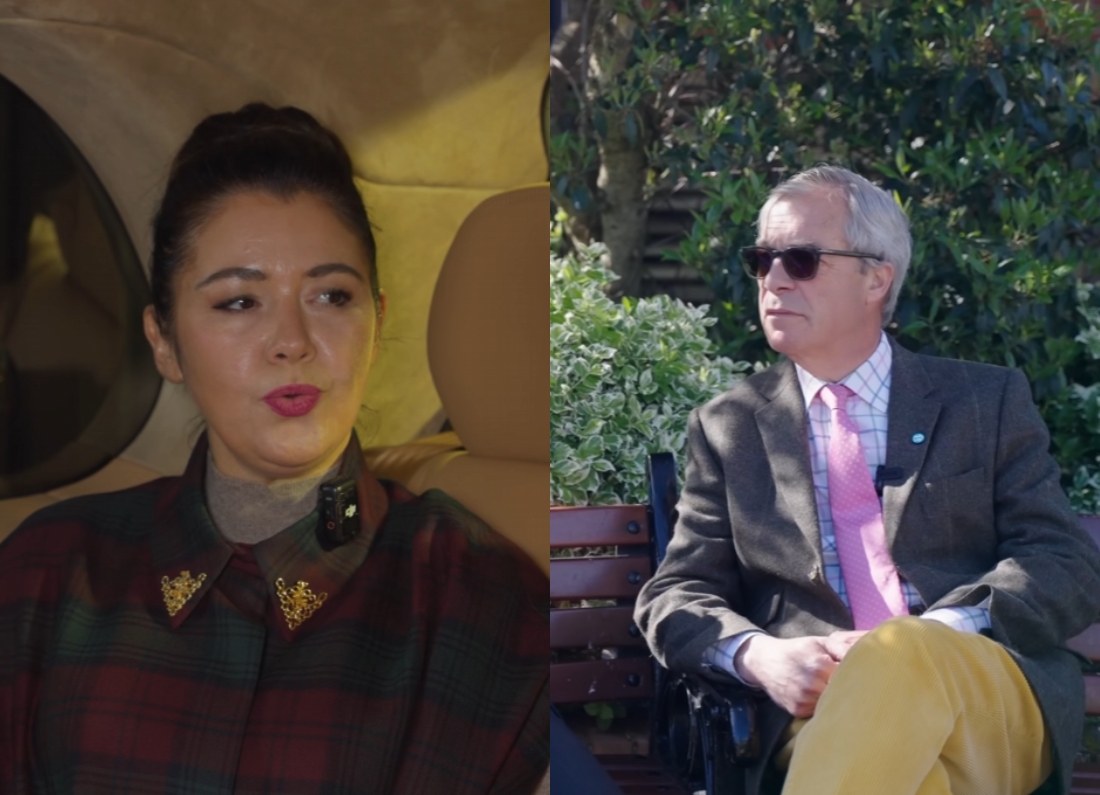
Nigel Farage‘s partner Laure Ferrari has refused to confirm how she paid for the £885,000 house in his Clacton constituency that Farage initially claimed to have bought himself – adding to a week in which the Reform leader has faced intensifying scrutiny over his personal financial arrangements, including the undisclosed £5 million gift from crypto billionaire Christopher Harborne.
Ferrari, 46, made the comments in an interview with French newspaper Le Monde. When asked whether she bought the property in Frinton-on-Sea through a family inheritance, she said: “Yes and no, that would be a very large inheritance… There’s more than one way to pay for a house.”
She added: “I can’t say how much my grandmother gave, that’s my business. The main thing is that I paid all the taxes, there was no tax evasion, and the house is in my name.”
The Clacton house story so far
The Guardian first reported last year that the Clacton-area house, which Farage initially said he had bought himself, was in fact wholly owned by Ferrari. Farage subsequently said the ownership structure was for “security” reasons.
The arrangement carries a specific financial dimension beyond security. Ferrari purchasing the property in her name would have saved Farage an estimated £44,000 in stamp duty, as he would have been liable for the higher rate given he already owns other properties. Farage has denied that this was a motivation and has denied lending or giving Ferrari money toward the purchase.
“I haven’t lent money to anybody. I didn’t give her money,” Farage said last September. “She comes from a very successful French family and she can afford it herself. It’s convenient, it works, and she loves it there.”
What the BBC investigation found
Farage’s claim that Ferrari comes from a “very wealthy French family” was subsequently examined by a BBC investigation. The findings raised questions about the scale of that wealth.
Ferrari’s father’s haulage business in Strasbourg was liquidated in 2020. Her parents are living in a flat in a suburb of Strasbourg worth approximately £300,000, co-owned by the couple and their two daughters. The family also own the former premises of the haulage company, which is rented out for an estimated €8,000-€9,000 a month – approximately £85,000 to £95,000 a year.
These are not the assets of an impoverished family. But they are also not obviously the assets of a family that could comfortably write an £885,000 cheque for a house in Essex – still less a family described as “very successful” and “very wealthy” in a way that would make the transaction unremarkable.
Ferrari’s Le Monde interview
In the Le Monde interview, Ferrari was described as “dodging” the question of how the property was funded. Her answer – that her grandmother contributed something, that a large inheritance would not account for it, that there are multiple ways to buy a house and that she paid all applicable taxes – raises more questions than it answers.
She confirmed the transaction was legal and fully taxed. She declined to specify the source or sources of funds. The combination of “there’s more than one way to pay for a house” with “I can’t say how much my grandmother gave” suggests the purchase may have involved multiple funding sources, but Ferrari has not confirmed what those were or whether any of the money came from Farage directly or indirectly.
In the same interview, Ferrari revealed aspects of her influence on Farage’s political career, saying she “encouraged” three key moments: his decision to leave UKIP, his appearance on ITV’s I’m a Celebrity Get Me Out Of Here!, and his decision to run for parliament in 2024 rather than staying in the US to campaign for Donald Trump.
On the prospect of Farage becoming Prime Minister, she said: “I don’t want to tempt fate, but a lot can happen between now and the elections.” She added that she would enjoy diplomatic events: “I really like ambassador’s dinners, Ferrero Rocher, that sort of thing.”
She was also keen to draw a line between her own potential role and that of Carrie Johnson during Boris Johnson’s time in Downing Street. “She intervened far too much in the country’s affairs. If people elect Nigel Farage, they are not electing Laure Ferrari.”
Labour’s response
Labour called on Farage to provide a full explanation of how the Clacton property was funded, connecting it directly to the Harborne gift story.
“Last week we discovered that Nigel Farage failed to declare a £5 million donation from a crypto-billionaire and this week we discover that Farage’s partner might not have paid for all of his house in Clacton after all,” a Labour spokesperson said. “The leader of Reform needs to stop dodging scrutiny and urgently answer questions about this purchase. Farage has failed to be straight with the public over the full facts.”
The accumulating picture
The Clacton house story, the Harborne gift story and the 17 previous late declarations now form a pattern that Reform and Farage have consistently framed as a combination of legitimate personal arrangements, administrative errors and politically motivated media scrutiny.
The specific financial questions accumulating around Farage in the days before the local elections are:
A £5 million personal gift from a Thailand-based crypto billionaire, received before he stood for parliament and not declared. A £885,000 house in his constituency, initially claimed as his own purchase, subsequently revealed to be owned by his partner, with the funding sources still not fully explained. Seventeen late declarations of earnings totalling £384,000, found inadvertent by the standards commissioner. A parliamentary standards investigation now open into the £5 million gift.
Reform is polling at 27% and is widely expected to make significant gains on Thursday. Farage has dismissed all of these questions as politically motivated smear campaigns. His critics argue that a man seeking to become Prime Minister has an obligation to answer basic questions about his personal finances. Ferrari’s Le Monde interview has not made those questions easier to answer.
You may also like: Reform’s plan to scrap renewable energy contracts could trigger Truss-style chaos, industry chief warns