

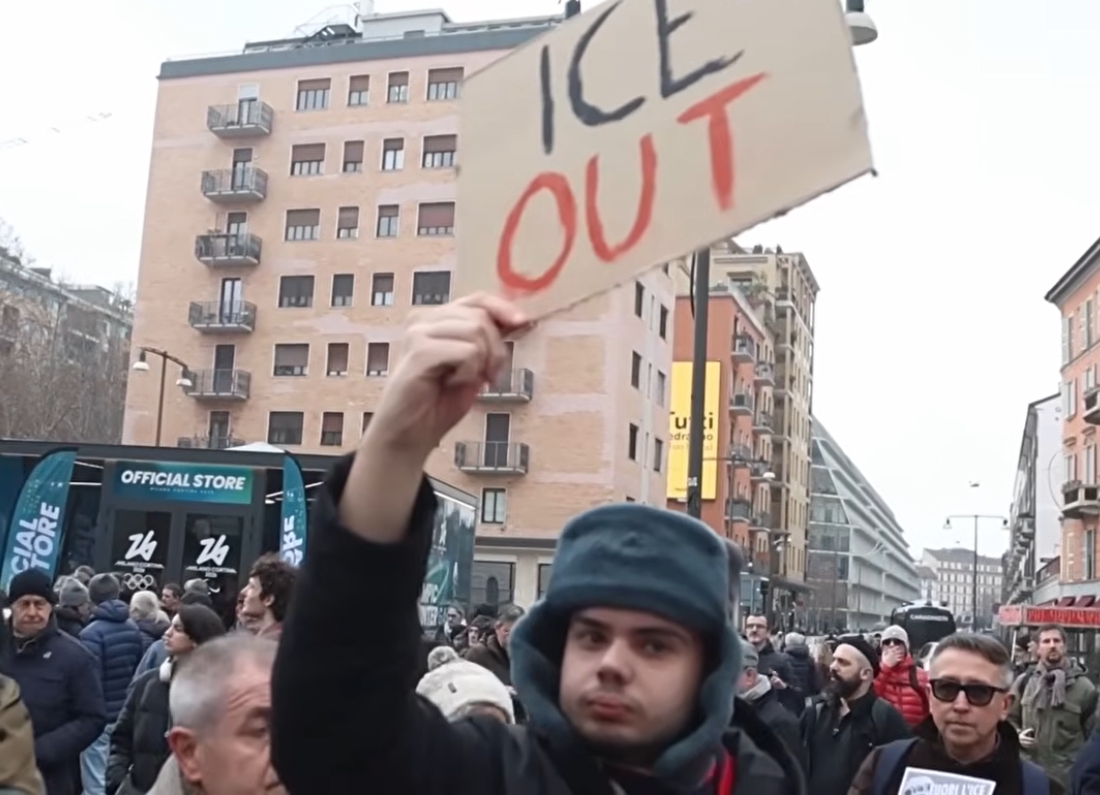
Hundreds of people gathered in central Milan at the weekend to protest plans for officers from a specialist arm of U.S. Immigration and Customs Enforcement to support security operations during the 2026 Winter Olympics.
Demonstrators assembled in Piazza XXV Aprile, a location associated with Italy’s Liberation Day commemorations, and framed their protest as both a rejection of the proposed deployment and a wider statement about political direction in the United States.
The controversy centres on a planned role for Homeland Security Investigations, a unit within ICE that focuses on transnational crime and routinely works with overseas partners. Italian officials have said the personnel involved would be based in a control-room setting linked to the US Consulate in the city, and would not be conducting street-level immigration enforcement in Italy.
Even so, the news has provoked a visible public backlash, with protesters arguing that any formal presence connected to ICE is unacceptable given the agency’s role in the Trump administration’s immigration enforcement at home. At the demonstration, banners included messages such as “Never again means never again for anyone” and “Ice only in spritz”, alongside more confrontational slogans directed at US policy.
What Italy and the US have said about the Olympic role
Italy’s Interior Ministry has tried to draw a firm line between the Olympic support role and the most politically contentious parts of American immigration enforcement, stressing that the officers expected in Milan would be from HSI and stationed in a support environment rather than operating in public spaces. Italian statements have also pointed to the fact that HSI personnel work internationally and have had a presence in Italy for years.
US briefings reported by international media have similarly described the deployment as advisory and intelligence-focused, aimed at helping protect the US delegation and sharing expertise related to transnational threats that can intersect with major events.
That distinction has not satisfied critics in Milan, who say the ICE name and brand have become inseparable from enforcement tactics and political messaging in the United States. Protesters interviewed by wire services said they were concerned by what they view as the export of a hardline approach, even if the personnel involved are not from the specific operational units most associated with domestic raids.
Why local politics in Milan has been pulled into the dispute
The planned support role has also become a political issue inside Italy. Giuseppe Sala has publicly criticised the idea of ICE-linked personnel being involved during the Games, and Italy’s government has faced questions about why the arrangement was agreed in the first place.
Italy’s interior minister, Matteo Piantedosi, has been drawn into the row, with reports noting parliamentary scrutiny and public pressure to clarify the scope of the deployment and the safeguards around it.
For organisers and security planners, the episode highlights a recurring challenge for global sporting events: multi-agency coordination is normal, but the public acceptability of that coordination can change quickly when a participating body becomes a symbol in a broader political argument.
What protesters said they were objecting to
At the Milan rally, participants described the demonstration as a stand against what they see as a wider drift towards authoritarian politics in the United States, using language such as “creeping fascism” in speeches and placards. Some compared ICE to historical secret police organisations — a comparison that is politically charged and contested, but which captured the anger among parts of the crowd.
Several protesters specifically referenced recent high-profile incidents in the United States involving immigration enforcement, saying the images and rhetoric associated with ICE had made them uneasy about any formal Olympic-linked role. Interviewees told reporters they did not regard the distinction between ICE divisions as meaningful in the current climate, arguing that the symbolism was the point.
Others, including trade union and centre-left participants, framed the protest more narrowly as an attempt to keep Olympic security arrangements within an Italian and European framework, rather than leaning on the involvement of foreign agencies that have become politically controversial.
What happens next as the Games approach
The 2026 Winter Olympics are scheduled to open on 6 February 2026, with events staged across northern Italy. With the start date approaching, officials face a limited window to calm tensions, clarify the operational details and prevent the issue from overshadowing preparations.
One likely next step is further public explanation of what HSI officers would and would not be doing in Milan, including where they would be based, what Italian authorities’ oversight would look like, and what formal agreements underpin their presence. While governments often treat these arrangements as technical, the size of the backlash suggests they will now be handled as a political communication issue as well.
For now, the central dispute remains unresolved: officials say the role is limited and advisory; opponents argue that the “ICE” label carries reputational and moral weight that cannot be separated from any Olympic involvement.
Related: What is ICE? The US agency explained for UK readers





Leave a Reply