

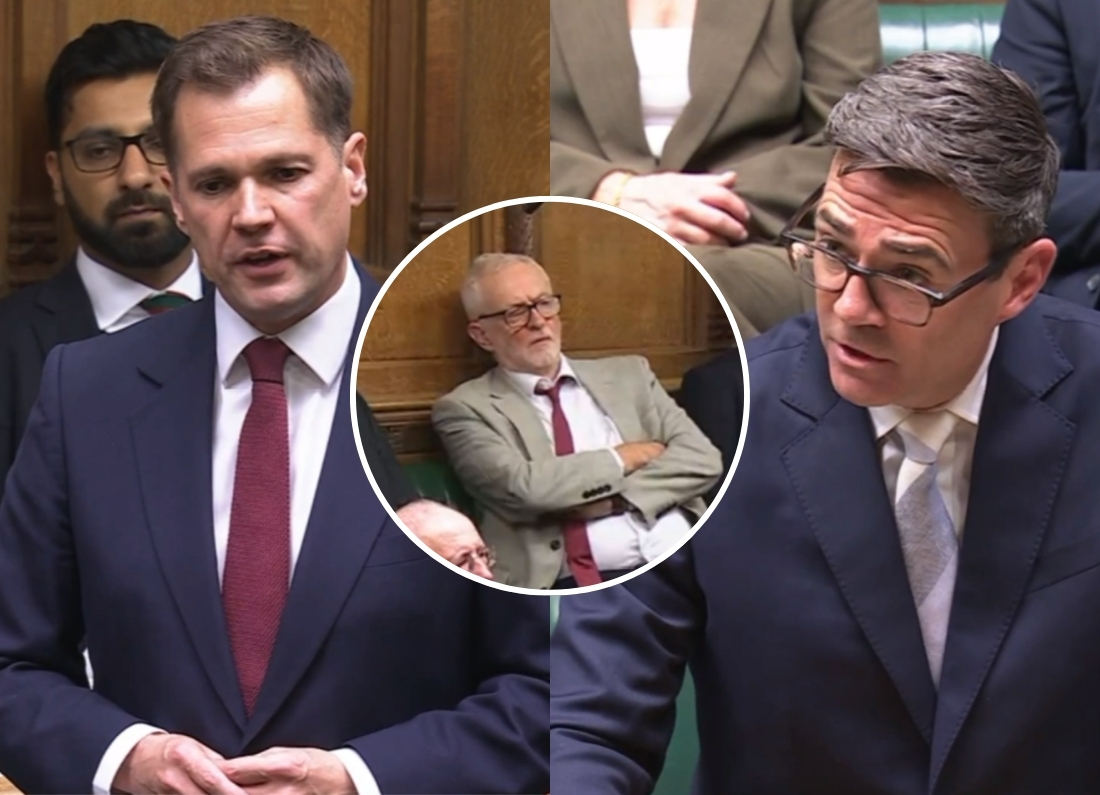
Andy Burnham turned Robert Jenrick’s attack over small boat crossings back on the Reform UK MP’s own record in government after he demanded that Britain declare a national security emergency and send the Royal Navy into the Channel.
Jenrick used a Commons intervention to link concerns over Iran to Britain’s asylum system, arguing that Iranian agents charged with terrorism offences had entered the country by small boat and claiming the government had left a “gaping hole” in Britain’s borders.
He told Burnham:
“We now know that Iran has targeted bases on our soil. We already knew that Iranian agents, who had been charged with terrorism offences, entered the United Kingdom on small boats.
“So will he do what we would, which is declare a national security emergency? Because we have a gaping hole in our borders right now.
“Send the Royal Navy into the Channel and shut down the entire asylum farce once and for all to truly fulfil his duty as Prime Minister, which is to keep the British people safe.”
Burnham’s response was considerably shorter.
He said:
“I can remember a time when the right hon. Gentleman stood up in this House and made serious proposals. Sadly not today.
“If he checked the facts recently, he will see that small boat crossings are coming down under this government.
“When he was Immigration Minister, what did they do? They went up and up and up. Those are the facts. He should engage with them.”
The exchange quickly spread online, helped by Jeremy Corbyn sitting behind Jenrick and appearing increasingly unimpressed as the Reform MP continued speaking.
Small boat crossings are down this year
Burnham’s central claim that small boat arrivals have fallen under the current government is supported by official figures.
The Border Security Commander’s annual report said arrivals in the first half of 2026 were down 41 per cent compared with the same period in 2025, while the number of boats fell by 47 per cent.
The report said the reduction had coincided with increased arrests, seizures and international enforcement against organised immigration crime, although officials cautioned that crossings remained volatile and influenced by weather, smuggling tactics and conditions in northern France.
Separate Home Office figures showed 33,374 people arrived by small boat in the year ending June 2026, down 23 per cent from 43,309 during the previous 12 months.
The fall became more pronounced during 2026 itself. By early September, the number arriving since January was around 43 per cent lower than over the same period in 2025.
Crossings have not stopped, and early October produced several busy days. Between 2 and 6 October, 1,620 people arrived in 21 boats, including 609 people on 5 October alone.
That volatility is one reason ministers have avoided claiming the problem has been solved, despite the clear year-on-year reduction.
Jenrick was immigration minister during the small-boats crisis
Burnham’s attack landed because Jenrick previously held direct responsibility for immigration policy.
He served as immigration minister from October 2022 until December 2023 under Rishi Sunak, having taken office near the end of the year in which Channel crossings reached their record annual peak.
Around 45,800 people arrived by small boat in 2022, the highest annual total recorded. The number then fell substantially during 2023.
That means Burnham’s line that crossings simply “went up and up and up” while Jenrick was immigration minister is more rhetorical than the full annual statistics support.
The longer Conservative record is much less comfortable for Jenrick. Small boat crossings rose from just 299 people in 2018 to 8,466 in 2020, 28,526 in 2021 and almost 46,000 in 2022.
Jenrick entered the immigration brief in October 2022, when the system was already dealing with the highest level of small boat arrivals on record. In a letter written while minister, he said around 85,000 people had crossed since 2018, including roughly 45,000 in 2022 alone, and warned that the asylum system had become overwhelmed.
His government responded with the Illegal Migration Act, the Rwanda deportation plan and tighter asylum measures, although the Rwanda scheme never became operational before Labour won the 2024 election.
Jenrick now wants the Royal Navy sent into the Channel
Since joining Reform, Jenrick has adopted an even harder position.
He has backed Nigel Farage’s plan to use military personnel to intercept small boats and return them towards France, while Reform says it would leave the European Convention on Human Rights, repeal the Human Rights Act and suspend much of the existing asylum system.
Jenrick caused a separate row this week when he said Royal Marines involved in Channel operations would be able to use lethal force if they were attacked.
Farage later rejected suggestions that Reform wanted troops shooting at migrant boats, telling LBC that force would only be used in self-defence if British personnel came under attack.
Defence minister Luke Pollard described Jenrick’s language as “disgusting and illegal” and argued that the military could not simply be deployed against unarmed civilians attempting to cross the Channel.
Reform argues that deploying the Navy and Marines would quickly deter crossings because smugglers and migrants would know boats would not be allowed to reach Britain.
Iran has become part of the immigration argument
Jenrick’s intervention came amid growing security concerns over suspected Iranian activity in Britain.
Burnham said on Sunday that the government assesses Iran’s Islamic Revolutionary Guard Corps as “almost certainly” responsible for a recent security threat involving RAF Fairford, the Gloucestershire airbase used by the United States.
Seven people have been arrested during the investigation into suspected activity around the base, including a dual British-Iranian national. They were subsequently released on bail while counter-terrorism officers continued their inquiries.
Separately, three men are currently standing trial accused of carrying out surveillance connected to an alleged Iranian intelligence operation targeting UK-based journalists and activists. All three deny the charges.
Jenrick used those wider concerns to argue that irregular migration through the Channel represented a national security vulnerability.
His specific claim that Iranian agents charged with terrorism offences entered Britain on small boats was not substantiated during the Commons exchange, and the publicly reported Iranian-linked cases currently before the courts involve several separate investigations with different allegations and circumstances.
Corbyn’s reaction gets almost as much attention
The clip attracted another audience online because Jeremy Corbyn was sitting directly behind Jenrick during the exchange.
As Jenrick called for a national security emergency and the deployment of the Royal Navy, Corbyn could be seen watching from the benches with an expression that quickly became part of the social-media reaction.
@HKW1981 wrote:
“Corbyn’s face is an absolute picture”
@laurnorman said:
“More amusing is to watch Corbyn’s look of complete contempt listening to Jenrick.”
Others concentrated on Jenrick’s previous record in government.
@MittensOff wrote:
“And there it is, Jenrick shouts for a ‘National Emergency’ when boat crossing are significantly down, and went significantly up under his tenure. Arse on a plate time.”
@Pete_Js added:
“It is weird how @RobertJenrick never once considered doing this when he was overseeing much greater numbers. Why is that?
“I know reformers are thick, but does he expect no one to remember that he did nothing about a much greater influx?
“He’s such a moron.”
And @Vmartine1905 asked:
“Why didn’t he send the Navy when he was in power??”







Leave a Reply