

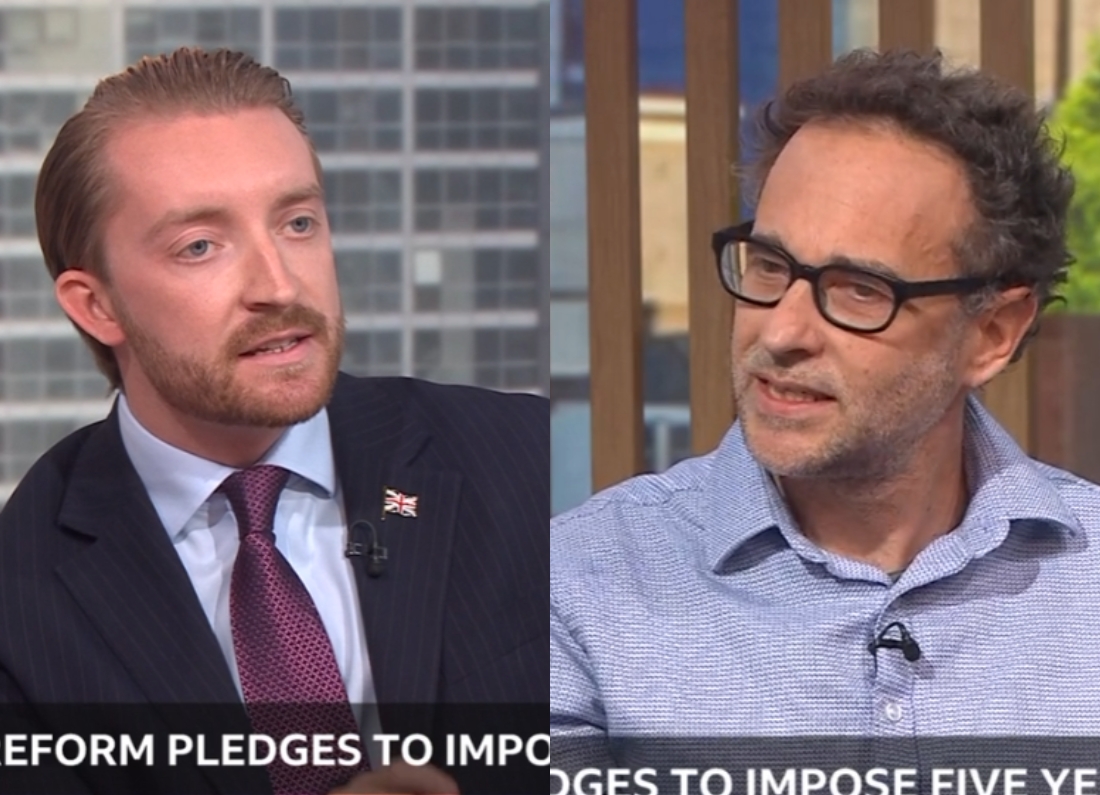
Reform UK spokesman Jaymey McIvor was left sitting in silence on BBC Politics Live after journalist Rafael Behr delivered a sustained attack on Nigel Farage’s latest immigration policy, accusing the party of turning a relatively small group of migrants into the answer for decades of anger over housing, public services and the economy.
The exchange came after Reform unveiled plans to effectively suspend Britain’s asylum system for five years if it wins the next general election. Farage says the party would invalidate around 90,000 pending applications, automatically reject new asylum claims, close legal resettlement routes apart from protections for Ukrainians already here, and seek to deport those it says have no right to remain.
Reform also says it would leave the European Convention on Human Rights, repeal the Human Rights Act and, at least temporarily, disapply the 1951 Refugee Convention in order to remove legal barriers to its plans.
Appearing alongside McIvor on Politics Live, Behr said there were two separate arguments that needed to be distinguished.
He first acknowledged that some of Reform’s proposals were possible if a future government was prepared to abandon international agreements Britain had previously signed.
Behr said:
“First of all, there’s two important points here. One, you can conjure up the Royal Navy to say we will just enforce the deportation.
“And you can say, yes, we’ll leave the European Convention. You might say you could leave the UN Refugees Convention.
“There are lots of things. These are realistic ideas if you’re prepared to go that far.
“But it also means you’re prepared to say that the UK should be a country that tears up international treaties.
“Fine, maybe that’s Reform policy. I don’t know. We can find out in an election whether that’s the country British people want.”
That is now broadly where Reform does stand. Farage said on Sunday that Britain would have to leave the ECHR, repeal the Human Rights Act and “disapply the 1951 Refugee Convention” in order to implement the party’s plans.
Behr turns to the wider argument
Behr then moved away from the legal question and challenged the way Reform links immigration to broader dissatisfaction with the state of Britain.
He accused the party of taking genuine public anger over overstretched services and presenting irregular migrants as the central explanation for problems that have built up over decades.
Behr told McIvor:
“But there’s a separate issue of proportionality here. What you’ve done, and it’s a very effective piece of rhetorical sleight of hand, where you say there are some abuses of the system and they relate to a small number of people.
“And people get very upset about that and they justifiably feel maybe their public services aren’t adequate. Maybe they don’t get the housing care they want. Maybe the NHS isn’t providing for them exactly the way they would want.
“And then there is a small number of people. I mean, maybe you think it’s too many, but there’s still a small number of people who are illegal migrants who are getting some kind of public service.”
McIvor listened without interrupting as Behr continued.
“And then you are heaping the entirety of national dissatisfaction with the state of the economy and the state of public services going back decades.
“And you’re saying, we don’t really have a policy to address these structurally. We don’t really have an economic policy. We don’t really have a housing policy. We don’t really have a clue what we’re going to do with the NHS.”
Behr then delivered the line that has since been widely shared online:
“But if we can vilify the entire population of illegal migrants and make them the receptacle of all the anger and blame and then come up with a theory to deport them, you’ve brilliantly solved all of the UK’s problems.
“And it’s a very, very effective piece of politics. It’s very, very traditional nationalist politics.
“But it’s not actually a policy for the UK to function as a country.”
What is Reform actually proposing?
Farage unveiled the latest version of Reform’s asylum policy on Sunday, describing the current system as a “national security emergency”.
The party says anyone entering Britain illegally would become ineligible for asylum. Its wider Operation Restoring Justice programme proposes identifying, detaining and deporting people it considers to be living in Britain illegally, supported by a new UK Deportation Command and a major expansion of detention capacity.
Farage has also threatened sanctions against countries that refuse to take people back, including visa restrictions, tariffs and potentially restrictions on airlines and airspace.
The newest proposals go further by suspending the granting of asylum altogether for up to five years. Around 90,000 pending claims and appeals would effectively be voided, while refugee status granted in recent years could be reviewed where Reform considers countries of origin to have become safe.
Women and children would not receive a general exemption from the deportation policy.
Farage argues that exceptional measures are justified because the asylum system has become unmanageable and because existing international agreements prevent elected governments from exercising sufficient control over Britain’s borders.
Leaving the ECHR would not settle every legal question
Behr’s comment that Reform could simply choose to leave international treaties needs some qualification.
A government with a parliamentary majority could legislate to withdraw Britain from the ECHR and repeal the Human Rights Act. Reform could also seek to withdraw from or disapply domestic effect given to parts of the Refugee Convention.
However, Britain has other international obligations that would continue to affect removals unless they too were changed or abandoned.
One of the central protections is the principle of non-refoulement, which prevents refugees being returned to places where they face persecution. Article 3 of the ECHR separately prevents someone being removed where there are substantial grounds for believing they face torture or inhuman or degrading treatment.
Existing Home Office guidance makes clear that even where parts of the Refugee Convention allow protection to be withdrawn from particularly serious criminals or national-security threats, other international obligations can still prevent their removal.
That is why Reform’s proposals would involve considerably more than passing one immigration act. They would represent a fundamental rewriting of Britain’s post-war human-rights and refugee framework.
The numbers behind the argument
Reform’s latest policy announcement comes as the number of people waiting for an initial asylum decision has fallen sharply.
Home Office figures show 40,168 people were awaiting an initial decision at the end of June 2026, down 56 per cent in a year and at the lowest level since June 2019.
A much larger number, 93,293 people, were receiving some form of asylum support at the same point, because that figure also includes people waiting for appeals and some failed asylum seekers who cannot immediately leave Britain.
There were 85,891 asylum applications in the year ending June 2026, representing a fall of around 21 per cent compared with the previous year.
Those figures do not make the political argument over immigration disappear. Small boat crossings remain highly visible, asylum accommodation still costs the taxpayer substantial sums and governments have struggled for years to remove people whose claims have failed.
But Behr’s argument was about scale. Britain has a population of roughly 70 million, an NHS treating tens of millions of people, a chronic housing shortage that predates the small-boats phenomenon and longstanding problems with low investment and weak productivity.
His challenge to Reform was whether deporting irregular migrants could plausibly deliver the broader economic and public-service improvements the party often associates with tighter immigration control.
McIvor has had a difficult few days on television
The Politics Live appearance came only days after McIvor found himself on the receiving end of another uncomfortable exchange on Newsnight.
He had gone on the programme to defend Reform’s internal investigation into allegations surrounding political donations and polling. When McIvor said the inquiry had found that “no laws were broken”, broadcaster Richard Bacon responded:
“According to your mates!”
Former Scottish Conservative leader Ruth Davidson then joked:
“My mum says I’ve done nothing wrong!”
Reform maintains that its investigation was serious and found no breach of electoral law, although the Metropolitan Police inquiry into the underlying allegations remains ongoing.
On Politics Live, McIvor again became the focus of attention after Behr finished his criticism of the asylum policy without receiving an immediate response.
The clip quickly spread online
The exchange was widely shared after Politics Live aired, with much of the reaction focused on McIvor sitting silently while Behr spoke.
@ScarthLloyd wrote:
“Reform’s Jamie McIvor sitting there blinking in the face of Behr’s irrefutable logic is a beautiful thing to see.”
@jamesdavidmagee said:
“What a brilliant take down!
Huge respect Rafael Behr 👊”
@rcuffy wrote:
“Word perfect and beautifully delivered”
And @richardwadams added:
“This was as big an intellectual mismatch as you’ll ever see.”
Another viewer, @kwrmag, focused on Behr’s wider argument:
“Populism only has grievances but never solutions and if their ‘policies’ do not work it’s the blame game currently directed towards immigrants. After that who is next ? Welfare benefit claimants, etc etc”










Leave a Reply