

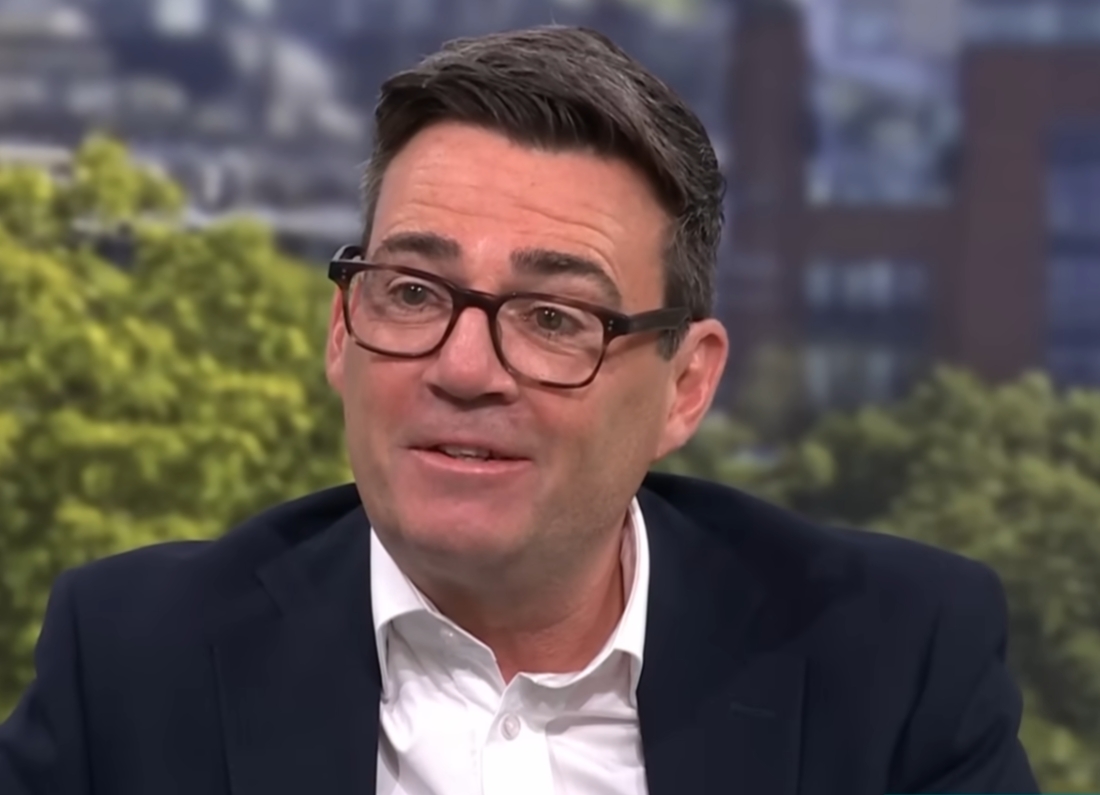
Labour has opened up a five-point lead over Reform UK in the latest YouGov poll, its biggest advantage with the pollster since the beginning of last year and another sign that Andy Burnham may be enjoying a significant post-conference bounce.
The new YouGov survey for The Times puts Labour on 27 per cent, up three points from the previous poll, while Reform has fallen three points to 22 per cent. The Conservatives are on 20 per cent, leaving Kemi Badenoch’s party just two points behind Nigel Farage and raising the prospect of an increasingly competitive battle on the right.
The movement is particularly striking because YouGov had Reform ahead only a week earlier. Its poll conducted on 27 and 28 September put Reform on 25 per cent, Labour on 24 per cent and the Conservatives on 19 per cent. Labour has therefore moved from one point behind Reform to five points ahead in the space of a week.
That does not mean six points of voters have simply moved directly from Reform to Labour, and individual polls can move around because of sampling and methodology. But the direction fits a broader pattern seen since Burnham replaced Keir Starmer and became prime minister.
A Burnham bounce after conference
The latest fieldwork followed Burnham’s first Labour conference as prime minister, where he made a series of interventions on Europe, social care, the state pension and political reform.
Rather than trying to avoid Brexit as previous Labour leaderships often did, Burnham openly said Britain should consider every option for its future relationship with the European Union, including a customs union, single-market membership and potentially full EU membership.
He also used conference to make the case for a National Care Service providing free personal care, funded partly through reform of the state pension triple lock after 2030, while presenting electoral and constitutional reform as part of a wider attempt to rebuild trust in politics.
The Times described the new figures as evidence that Labour’s strategy of trying to consolidate voters on the centre-left may be working, with support for the Greens and Liberal Democrats having weakened since Burnham entered Downing Street.
That is particularly important because Labour’s problem during the final period of Starmer’s leadership was not simply voters switching to Reform. YouGov analysis of this year’s local elections found Labour was losing considerably more former supporters to the Greens than to Farage’s party.
Burnham therefore needs to do something politically difficult: regain progressive voters without giving Reform an easy route into Labour’s traditional working-class seats.
So far, the polls suggest he has had some success.
Reform has fallen sharply in just seven days
The movement in YouGov’s own series makes the result harder to dismiss as a difference between pollsters.
On September 29, YouGov reported:
Reform UK: 25%
Labour: 24%
Conservatives: 19%
Liberal Democrats: 12%
Greens: 11%
At the time, Reform had actually risen four points from YouGov’s previous survey.
Now Labour is five points clear.
It is too early to know whether the change will survive beyond the immediate aftermath of conference, but it comes alongside other evidence that Reform’s position is less dominant than it was earlier in 2026.
YouGov’s September favourability tracker found only 24 per cent of Britons had a favourable opinion of Nigel Farage, giving him a net favourability score of -45. That was 14 points worse than a year earlier and identical to Starmer’s rating shortly before his resignation.
Recent YouGov research into tactical voting has also produced difficult numbers for Reform. In a constituency where only Labour or Reform could realistically win, voters preferred Labour by 41 per cent to 26 per cent. Against the Conservatives, Reform lost the hypothetical head-to-head by 35 per cent to 20 per cent.
That matters under first-past-the-post because Reform does not simply need a high national vote share. It needs to win individual constituency battles against Labour and the Conservatives while preventing anti-Reform voters from coordinating against it.
Labour still has a long way to go
A five-point lead looks impressive compared with where Labour was earlier this year, but 27 per cent would hardly be considered a dominant vote share in most previous elections.
Britain’s party system has become unusually fragmented. Labour, Reform and the Conservatives are all clustered between 20 and 27 per cent, while the Greens and Liberal Democrats retain significant support of their own.
YouGov’s latest MRP model, based on nearly 17,000 interviews conducted before Labour conference, projected Labour as the largest party on 241 seats, but still 85 short of an overall majority. Reform was projected to win far fewer seats than it had in earlier models, although a large number of constituencies remained extremely close.
That model predates the latest Labour improvement, but it illustrates how difficult translating national polling into a Commons majority could be.
For Burnham, the more immediate significance is psychological. Labour spent much of the past year looking over its shoulder at Reform. It is now beginning to look like the party setting the pace again.
Majority now back Britain rejoining the EU
The poll contains another finding that may be even more significant in the long term.
YouGov found 52 per cent of voters now favour Britain rejoining the European Union, compared with 27 per cent opposed.
That gives supporters of EU membership a 25-point advantage and adds to a growing collection of surveys showing public opinion has shifted substantially since the 2016 referendum.
A separate large-scale poll published last week found 49 per cent supported rejoining the EU against 28.5 per cent opposed, while 54.9 per cent described Brexit as a failure.
Burnham’s decision to reopen the question therefore looks less electorally reckless than it might have done only a few years ago.
But there is an important second finding.
Despite majority support for rejoining, 64 per cent believe Britain should hold another referendum before doing so.
That suggests voters distinguish between supporting EU membership in principle and believing a government should be able to reverse Brexit without another direct public vote.
Burnham has so far stopped short of committing Britain to rejoining. Instead, he has promised to examine the available options and build a broader consensus over what should replace the current relationship.
Brexit could be becoming an advantage for Labour
Farage has repeatedly argued that reopening Brexit would play directly into Reform’s hands, allowing him to revive the Leave coalition that carried the 2016 referendum and helped transform British politics.
The early evidence does not yet bear that out.
YouGov’s poll has Labour gaining three points while Reform loses three at the same time that Europe has returned to the centre of political debate. The same survey also finds a clear majority favouring EU membership.
That does not prove Burnham’s European stance caused Labour’s improvement. Conference coverage, leadership ratings, policy announcements and ordinary polling variation will all have contributed.
But it does show the risk for Reform in assuming Britain still divides politically in exactly the same way it did in 2016.
At the start of this year, YouGov found Reform winning half of Leave voters while Labour dominated among Remain voters. As support for Brexit itself has weakened, that electoral coalition becomes more complicated for Farage. YouGov
Labour’s challenge will be avoiding the opposite mistake. A majority saying they would like to rejoin the EU does not automatically mean voters want Brexit to dominate another general election, nor does it settle the difficult questions about freedom of movement, budget contributions, regulatory alignment and what terms Brussels would actually offer.
For now, though, Burnham has taken a political gamble and received an encouraging first verdict.
A week ago, YouGov had Reform one point ahead of Labour.
Today, Labour leads by five.







Leave a Reply