

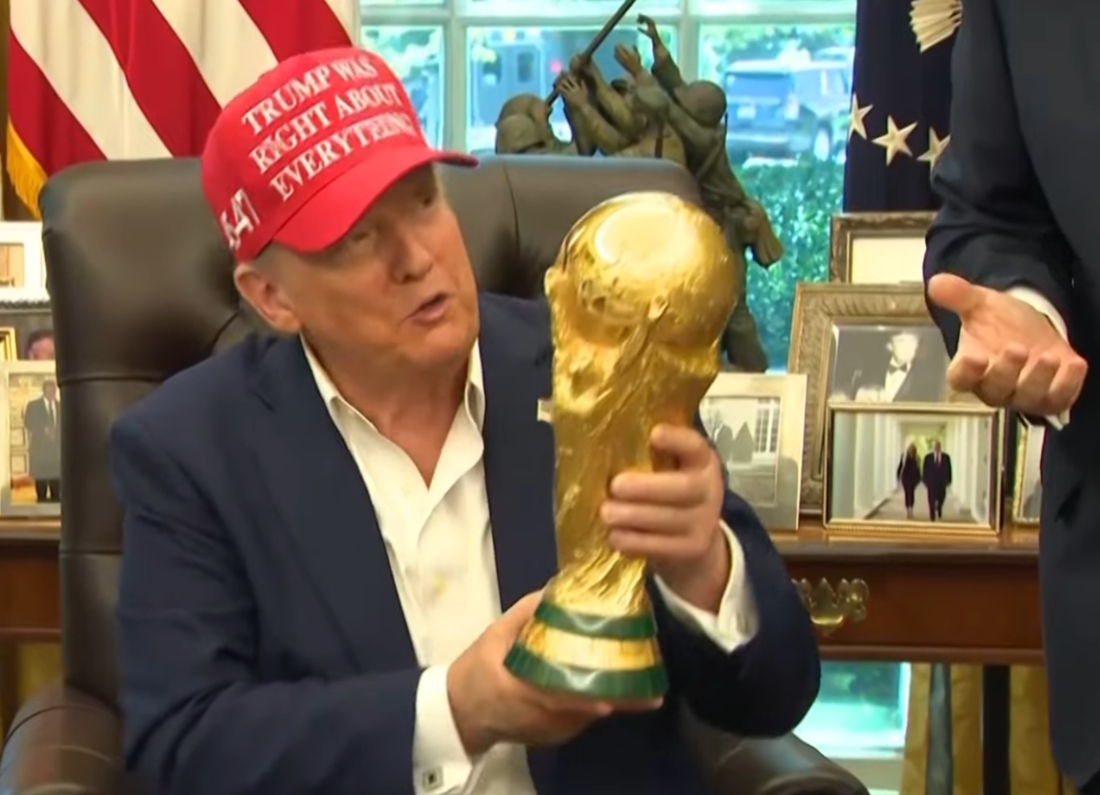
Spain lifted the trophy in the end, but for large stretches of this World Cup, Donald Trump behaved like the tournament belonged to him.
Not that the football itself let anyone down. England had their best World Cup since 1966 and got further away from home than they ever have. Spain eventually saw off Argentina to become world champions for the second time. Plenty for supporters to hold onto.
But everything happening around those matches often felt like a completely different event to the one FIFA kept promising.
Tickets priced out ordinary fans. Some people involved in the competition couldn’t even get into the United States. A World Cup referee was turned away at the border. Iran’s whole tournament was disrupted before a ball was kicked. And then there was Trump’s astonishing intervention in a disciplinary case involving a US player, followed by a final where he ended up front and centre alongside his good friend, FIFA president Gianni Infantino.
One Swiss TV commentator waited until the tournament was actually over to say what a lot of people had already been thinking. The clip has been doing the rounds online since, mostly because viewers appreciated someone finally refusing to treat all the organisational and political mess as background noise.
“The most commercial World Cup in history”
He opened with the obvious point. “There is no doubt that this was the most commercial World Cup in history and also one of the most politicised.”
Anyone who actually tried to go to a game will recognise that instantly. FIFA’s dynamic ticket pricing sent costs through the roof, especially once the knockouts started. Add in accommodation and travel across three enormous host countries, and the whole thing got financially brutal fast.
The expanded 48-team format meant more matches, more broadcast slots, more money for FIFA, and fans having to criss-cross vast distances between host cities to follow their teams. Watching at home, none of this mattered much. Trying to actually be there, in person, following your country? A very different story.
“We will not forget the prices that people without great purchasing power had to pay to live out their passion for football,” he said.
Worth sitting with that for a second. FIFA still likes to call football the people’s game. But increasingly, getting anywhere near its biggest tournament depends on whether you can afford premium pricing, long-haul flights and weeks of hotels.
People couldn’t even get into the country
There was also the small matter of hosting a global tournament in a country actively tightening its border restrictions.
Some fans, journalists and officials struggled to get into the US purely because of where they were from. The clearest example was Somali referee Omar Abdulkadir Artan, named Africa’s top male referee in 2025 and selected by FIFA to officiate at the tournament. Despite having, in his own account, all the correct paperwork, he was held and questioned for around 11 hours on arrival, then refused entry entirely. US Customs and Border Protection said he’d been flagged inadmissible over unspecified “vetting concerns,” without offering much public detail on what those concerns actually were.
Artan went home to Somalia, where he got a hero’s welcome, and said the experience was unfortunate but wouldn’t end his international career. Still, one of the continent’s most respected officials missed out on the biggest tournament of his life over it.
“In some cases, they couldn’t even enter the country because of their nationality, whether they were fans, journalists or even referees, like the Somali Omar Artan,” the commentator said.
FIFA’s line was that immigration decisions are the host government’s call, not football’s. True enough, technically. It still doesn’t answer the more obvious question: why didn’t FIFA push harder to guarantee entry for everyone it had officially accredited?
Iran’s tournament was compromised before it began
Iran had its own headaches, tied up in both visa issues and the wider conflict involving the country. The team relocated its training base from Arizona to Mexico after staff reportedly couldn’t get visas to enter the US. Iranian officials said support staff were denied entry outright; the State Department disputed parts of that account.
Either way, Iran went into this World Cup under conditions its opponents never had to deal with.
“We also remember the unacceptable treatment given to the Iranian national team, which was unable to properly defend its chances during the tournament,” the commentator said.
Whatever you think of Iran’s government, a national team is supposed to arrive at a World Cup on a level playing field. Punishing players and staff over geopolitics they had no control over kind of undermines the whole point.
Trump’s phone call changed everything
The biggest actual footballing controversy of the tournament involved US striker Folarin Balogun. He was sent off during America’s win over Bosnia and Herzegovina, which should have meant an automatic one-match ban, ruling him out against Belgium.
Trump called Infantino directly and asked for the decision to be looked at again. FIFA then suspended Balogun’s ban for a 12-month probationary period, and he played against Belgium anyway. Genuinely unprecedented for how red cards normally get handled at a World Cup.
Trump publicly thanked FIFA for reversing what he called a “great injustice.” Infantino insisted he’d simply told the president the case would go before FIFA’s independent judicial bodies, and that the process itself had stayed independent throughout.
Nobody was particularly reassured. UEFA said FIFA had crossed a “red line” and damaged the competition’s integrity. Belgium’s federation said it was astonished; manager Rudi Garcia compared the whole thing to an April Fools’ joke. Even England’s Thomas Tuchel asked where this actually ends if national federations and heads of state start demanding reviews on every contested card.
“We saw a president boast about calling the FIFA president to get a player’s suspension lifted,” the commentator said. “Politics has infiltrated the heart of football, even though FIFA claims to want to keep it above all else. It’s clear that this only holds true to a certain extent.”
That was arguably the story of the whole tournament. Whether or not the original red card was harsh barely matters. The problem is that a host nation’s president rang up FIFA’s president about a decision affecting his own team, and the punishment then vanished. Nobody should be shocked that people started asking questions about how independent any of it really was.
Four halves and a 27-minute interval
There was a smaller, weirder complaint too: how FIFA reshaped the actual rhythm of matches to fit commercial needs. Mandatory hydration breaks split most games into four effective quarters. The final itself had a half-time show that stretched the interval past 27 minutes, nearly double football’s usual 15.
Big entertainment at big events isn’t new. But this specifically felt like FIFA trying to bend football into the shape of American TV sport, with players and matches simply having to wait while the commercial show ran its course.
“It was a World Cup in which all matches were played in four halves, and whose final had a break of nearly 30 minutes,” he noted.
Small next to visa bans and presidential phone calls, sure. But it comes from the same place, treating football’s actual structure as something flexible whenever there’s more content, more sponsorship, or a broadcaster to keep happy.
Money and power, front and centre
Trump’s presence at the final tied all of it together. He sat next to Infantino, appeared at the presentation, helped hand the trophy to Spain’s captain Rodri, and stuck around long enough that a chunk of the crowd booed. He lingered on the podium as Spain got ready to celebrate, making sure the defining photo of the tournament had his face in it too, after years of Infantino publicly cultivating exactly this kind of closeness.
“The crisis has two names: money and power,” the commentator said. “Today, there is a crisis of trust between many of those involved in football and FIFA.”
He also suggested FIFA’s grip on funding to national federations helps explain why so few officials are willing to say any of this out loud. FIFA stays enormously powerful precisely because it controls the money, tournaments and development funding that football associations everywhere depend on. Plenty of people inside the game privately hate these decisions. Almost none of them will say so publicly.
The football can’t be separated from everything else, but it doesn’t have to be forgotten either
The reaction online was overwhelmingly on his side. One viewer said the games themselves had been great on TV, but the organisation around them was a mess. Another argued Spain’s win shouldn’t get to paper over the “absurdity” surrounding the whole thing. Others specifically liked that he’d talked about ticket prices from an ordinary fan’s perspective, rather than treating it as just another business story.
That’s really why the clip spread the way it did. It didn’t claim the football was bad, or that fans were wrong to enjoy it. It just refused to let the quality of the matches excuse the conduct of the people running the show around them.
Spain earned their trophy. The players earned their celebration. The fans earned a tournament worth remembering.
None of that means anyone has to pretend this wasn’t also a World Cup defined by unaffordable prices, people turned away at the border, and a level of political interference nobody had really seen before at this scale.
His point, in the end, was a simple one. Football should belong to the people who actually make it matter. After six weeks of Trump and Infantino making sure they were always somewhere near the camera, that felt like exactly the right note to end on.





Leave a Reply