

It all started, as these things so often do, with a very British Independence Day wind-up.
The good people at No Context Brits posted a photo of The Old Ferry Boat Inn, the thatched Cambridgeshire pub which claims to trace its origins back to 560 AD, alongside the caption: “America is 250 years old. This pub is 1,466 years old.”
A silly post, a gentle dig, and a reminder that some British pubs have been around so long they make most nation states look like new-builds.
The pub itself
For accuracy, the pub’s exact “oldest in England” claim is one of those wonderfully disputed bits of British pub history. Greene King says The Old Ferry Boat in St Ives traces its origin back to 560 AD and is widely believed to be England’s oldest pub, while Historic England’s official listing describes the current Ferry Boat Inn building as a 17th-century inn with an earlier cross-wing. So the post works as a joke, even if historians may keep a careful hand on the pump.
Still, it was Independence Day. The United States was marking 250 years since 1776. The British internet was doing what the British internet does best: being mildly irritating from behind a pint glass.
Naturally, some Americans took it in the calm, good-humoured spirit intended. And by that we mean: absolutely not.
DeSantis wades in
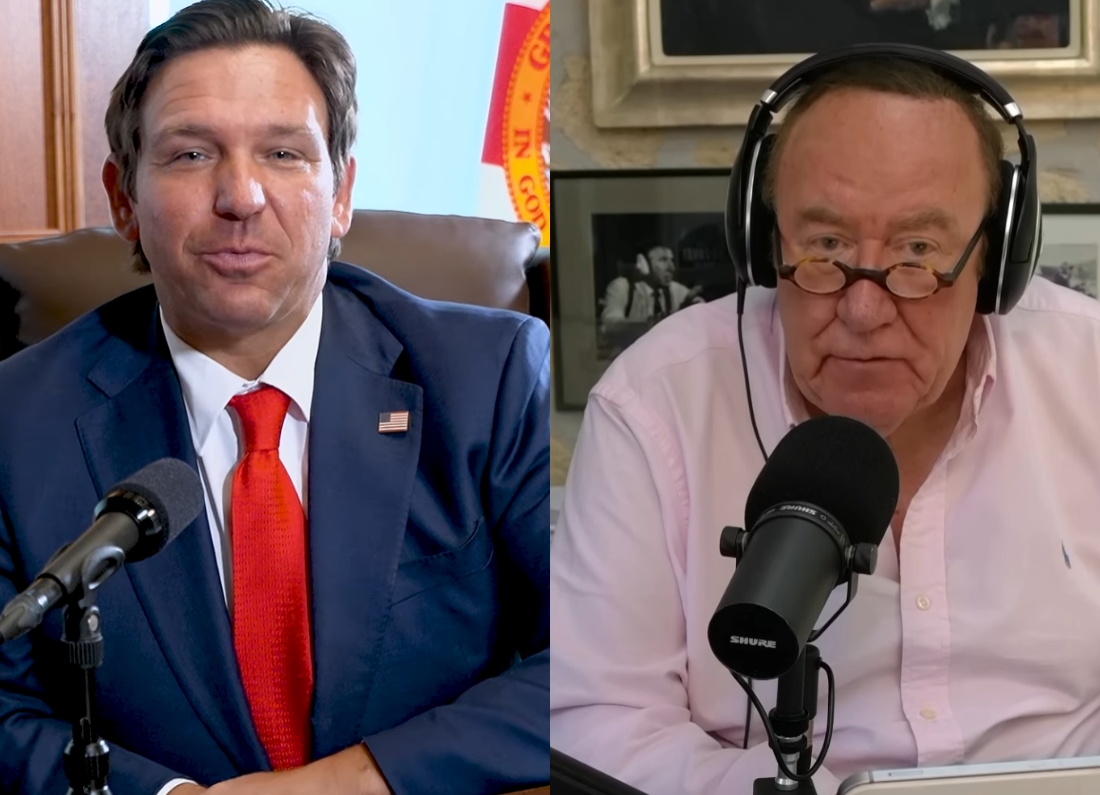
Among those who decided this required a serious response was Florida governor and one-time Republican presidential hopeful Ron DeSantis, who reached for the oldest line in the transatlantic pub argument playbook. Replying to the No Context Brits post, DeSantis wrote: “And if it wasn’t for America the insignia on the pub would be written in German.”
Oooh, get him.
The familiar “you’d all be speaking German without us” routine had been wheeled out again, polished up, and deployed against a thatched pub older than the Norman Conquest, the Magna Carta, the Tudor dynasty, the Act of Union and, indeed, the United States itself.
The problem, of course, is that history is a bit more complicated than a Florida governor’s comeback under a pub tweet.
What actually happened in 1939 and 1940
The United States did play a decisive role in the defeat of Nazi Germany. Nobody serious denies that. American industrial power, manpower, shipping, finance and military intervention were vital to the Allied victory. But DeSantis’s line implied that Britain had simply been sitting around waiting to be rescued until America arrived, which rather skips over several inconvenient years of actual history.
Britain declared war on Nazi Germany on 3 September 1939, more than two years before the United States entered the war. By the summer of 1940, after the fall of France, Britain and its empire were left fighting Nazi Germany in western Europe while the Luftwaffe attempted to gain air superiority ahead of a possible invasion. The Battle of Britain ended with Germany failing to secure the air supremacy it needed, forcing Hitler to postpone Operation Sea Lion indefinitely. The RAF calls it Nazi Germany’s first major military defeat.
That is the rather important bit in the middle of the story.
By the time the United States formally entered the European war, Britain had already survived the invasion threat of 1940. America entered the war after Japan attacked Pearl Harbor on 7 December 1941, with the US declaring war on Japan the following day. Nazi Germany then declared war on the United States on 11 December 1941, after which the US declared war on Germany.
Andrew Neil arrives
So when DeSantis did the usual “if it wasn’t for America” thing, Andrew Neil was passing through X with a sharp suit, a sharper tongue and apparently a free evening.
Neil replied: “Really? Your lot didn’t show up to help until 1942, when we’d already repelled German efforts to invade in 1940. Maybe you should stick to the local politics of your own Florida backyard. You’re clearly out of your depth on historic and geopolitical matters.”
To be filed under: you don’t have to like Andrew Neil to enjoy Andrew Neil doing this.
And he was not done.
When another user asked why America showed up at all if Britain did not need help, Neil replied: “Because Japan had bombed you and Hitler declared war on you. Don’t you have history books in the colonies?”
Again, rude. Also, not without a point.
The Lend-Lease detail everyone forgets
The United States was not some passive bystander before Pearl Harbor. Franklin D Roosevelt had already pushed through the Lend-Lease Act in March 1941, allowing Britain and other Allied nations to receive desperately needed supplies before America formally joined the war. US naval protection in the Atlantic also expanded during 1941, though Neil’s broader point was that full US entry into the war came after Pearl Harbor and Hitler’s declaration, not because Washington simply decided in 1940 to save Britain from invasion.
That is why the “you’d be speaking German” line is so lazy. It compresses the war into a cartoon version of events in which Britain did nothing, America arrived alone, and the rest of the Allies presumably stood around clapping.
In reality, the defeat of Nazi Germany depended on a vast alliance: Britain, the Soviet Union, the United States, occupied European resistance movements, Commonwealth forces, colonial troops, and many others. Britain did not win the war alone. America did not win the war alone. The Soviet Union bore a catastrophic share of the fighting and casualties on the eastern front. The Commonwealth and empire provided manpower, resources and strategic depth. The war was won by a coalition, not by a single national comeback line under a pub photo.
‘It wasn’t charity’
Neil also pushed back on another familiar American claim: that Lend-Lease was simply charity. When one user told him to “go relearn history,” Neil wrote: “We paid for what you sent us. It wasn’t charity. We were still paying off the loans 40 years later. You didn’t start US protection of Atlantic convoys til mid-1941, and even then it was limited. Of course we could not have defeated Germany without US intervention. But we had…”
The screenshot cut him off there, but the historical point is clear enough. Lend-Lease itself was not repaid in the simple way a normal commercial loan would be, but Britain did take out major post-war loans from the United States and Canada to keep its exhausted economy afloat after victory. The House of Commons Library records that repayment of the UK’s wartime loan to the US was completed on 31 December 2006, more than six decades after the war ended.
That does not diminish America’s role. It simply makes the history less like a superhero film and more like what it actually was: a brutal, expensive, multinational war followed by decades of economic consequence.
The GDP detour
Neil also had time for the economics bit. After an American account tried to mock Britain over GDP comparisons with Mississippi, Neil replied: “I say old chap, only poorer than Mississippi if you use nominal GDP values/exchange rates. Not good economics. Use purchasing power parities, more reliable for comparisons, and we don’t look so bad. Try them and you’ll see.”
There is something deeply funny about a pub tweet becoming a fight about purchasing power parity, but that is where the internet took us, and we must respect the journey.
The final punchline
And finally, Neil marked America’s birthday with the cleanest punchline of the lot: “HAPPY BIRTHDAY, AMERICA! Just think, if you hadn’t taken such a wrong turn 250 years ago you’d now be as admired, respected, liked, peaceful and civilised as Canada 😂😂😂”
Boom.
The whole thing was very stupid, very online, and very funny.
Why the joke actually matters
But underneath the jokes, there is a real reason the “you’d be speaking German” line annoys people so much. It is not because anyone serious denies America’s importance in the Second World War. It is because the line is usually deployed as a historical shut-down, as if Britain’s entire wartime experience began only when the United States arrived.
It erases 1939. It erases 1940. It erases the Battle of Britain. It erases the Blitz. It erases the Atlantic convoys before full US entry. It erases Commonwealth troops. It erases the Soviet front. It turns a world war into a meme about American exceptionalism.
And in this case, it was deployed in response to a joke about a pub.
A pub.
No Context Brits made a daft point about a building that claims to be older than America. Ron DeSantis tried to turn it into a World War Two morality play. Andrew Neil arrived with a history lesson, a debt reminder, a GDP correction and a Canada punchline.
Not bad work for one old British pub.





Leave a Reply