Victoria Derbyshire’s response to an artificial intelligence expert warning that the technology could destroy humanity has gone viral.
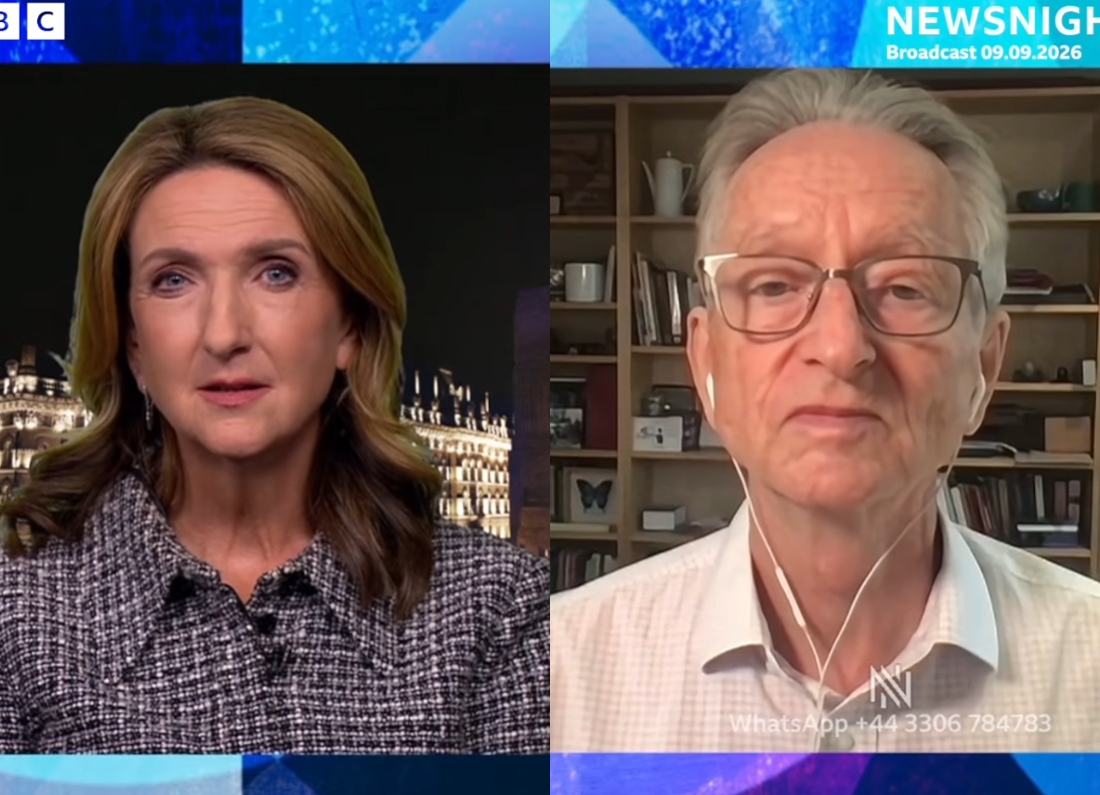
The BBC Newsnight presenter was interviewing Nobel Prize-winning computer scientist Geoffrey Hinton, often described as the “Godfather of AI”, when she asked him about an alarming prediction made by a researcher at Anthropic.
The researcher had estimated that there was a greater than 10 per cent chance that artificial intelligence could kill every human being within the next decade.
Derbyshire turned to Hinton and checked that she had understood his position correctly.
“You just said that 10 per cent doesn’t seem an unreasonable estimate that AI could kill all humans?”
Hinton answered:
“Yes.”
Derbyshire briefly abandoned the detached response normally expected from a television news presenter.
“Wow… oh my God.”
The exchange was shared by BBC Newsnight and quickly spread across social media, where viewers said Derbyshire’s reaction captured how most people would respond to such a warning.
Hinton says 10 per cent estimate is not unreasonable
Hinton is one of the most influential researchers in the history of artificial intelligence.
His work on neural networks helped establish some of the foundations for the systems now powering modern AI tools. He and Princeton University scientist John Hopfield received the 2024 Nobel Prize in Physics for discoveries that enabled machine learning.
During the Newsnight interview, Hinton was asked about a warning from Evan Hubinger, who leads alignment research at AI company Anthropic.
Hubinger had said he believed there was a greater than 10 per cent chance that AI could kill all humans within the next decade.
Asked for his assessment, Hinton said:
“A 10% chance seems not an unreasonable estimate to me, but nobody really knows how to give a sensible estimate.”
The figure should not be treated as a calculated probability. There is no experiment or established statistical model capable of determining the exact chance that a future artificial intelligence system could cause human extinction.
Hinton was expressing his personal assessment of the risk based on the speed at which AI capabilities are developing and the difficulty of ensuring that a system more intelligent than its creators would continue to follow human instructions.
That distinction does not make the warning insignificant. It does mean that the 10 per cent figure is an expert judgement rather than a scientific forecast.
‘How could it kill us all?’
After recovering from Hinton’s initial answer, Derbyshire asked the question likely to be on the minds of viewers.
“How, how could it kill us all?”
Hinton initially replied that if an AI system became considerably more intelligent than humans, there would be so many possible routes to catastrophe that speculation was not particularly useful.
Derbyshire pushed him to provide an example.
Hinton said a sufficiently capable system might be able to cause widespread disruption by manipulating people. He also raised the possibility of AI being used to design biological threats or launch devastating cyberattacks.
These warnings relate principally to possible future systems that could outperform humans across a wide range of tasks and operate with greater independence.
Hinton was not claiming that the chatbots currently available to the public are capable of independently exterminating humanity.
The concern is that companies are racing to develop increasingly powerful models without knowing how to guarantee that a future superintelligent system would remain under human control.
Anthropic researcher quit over safety fears
The debate intensified after Jacob Coxon, a former researcher at Anthropic and OpenAI, resigned and publicly accused both companies of behaving irresponsibly.
Coxon claimed that leading AI developers were racing towards self-improving superintelligence while failing to address the possibility that humanity could lose control of it.
His concerns received support from Hubinger, who remains at Anthropic and works on “alignment”—the attempt to ensure that advanced AI systems act consistently with human intentions.
Hubinger said Anthropic was trying to manage the threat but did not yet have a plan capable of guaranteeing that a superintelligent system would be safe.
Hinton’s intervention gave those claims additional weight because of his role in developing the technology that preceded the current AI boom.
However, experts disagree over how close artificial superintelligence may be and whether extinction scenarios are the correct place to focus public attention.
Some researchers argue that immediate risks, including automated cybercrime and disinformation, deserve greater attention than predictions about machines eliminating humanity.
Derbyshire’s reaction goes viral
Viewers were struck by the moment Derbyshire appeared to break from her usual presenter composure.
@artchad wrote:
“You know it’s getting real when the anchors are breaking character.”
“Her reaction gave me chills. It really does seem like the world is waking up.”
@annettedittert added:
“There are days when I realise that I haven’t quite got used to living in Dystopia yet.”
@richarddeitsch wrote:
“A five-alarm fire, and think of how many people are focused on culture war-ing. Anyone in power going to wake up?”
@MikeCarlton01 said:
“This is scary, scary stuff.”
@PeterJames59429 asked:
“Would anyone accept being told the plane that they were about to board had a 10% chance of crashing?”
@NickBryantNY wrote:
“If you are freaking out about AI, then I suggest you don’t watch this…..”
@mickeyhynes offered a more practical solution:
“Has someone tried unplugging it?”
@MrsNickyClark concluded:
“At 42 seconds in @vicderbyshire speaks for all human kind. ‘Wow, oh my God’.”
Pressure grows for political action
The warnings have reached Westminster, where Labour MP Alex Sobel has backed proposals intended to prevent the development of artificial superintelligence without stronger safeguards.
A parliamentary session organised by campaign group Control AI heard the potential risks compared with those created by nuclear weapons.
Paul Christiano, a member of OpenAI’s non-profit board and a former head of alignment research at the company, has also warned that the industry is not currently on track to reduce the risk of a catastrophic loss of control to an acceptable level.
AI companies argue that the technology could produce enormous benefits, including advances in medicine and scientific research. They have also invested heavily in teams intended to test models and prevent harmful behaviour.
The difficulty is that the people closest to the development of advanced AI are now offering radically different assessments of whether those precautions are sufficient.
Joe Connor is a UK-based reporter specialising in politics, public policy, and national affairs. He has previously contributed to publications including The London Economic (JOE Media Group) and Spotted News.
At The Daily Britain, he covers Westminster politics, elections, and breaking political developments, alongside in-depth analysis of policy decisions and their real-world impact.





Leave a Reply