

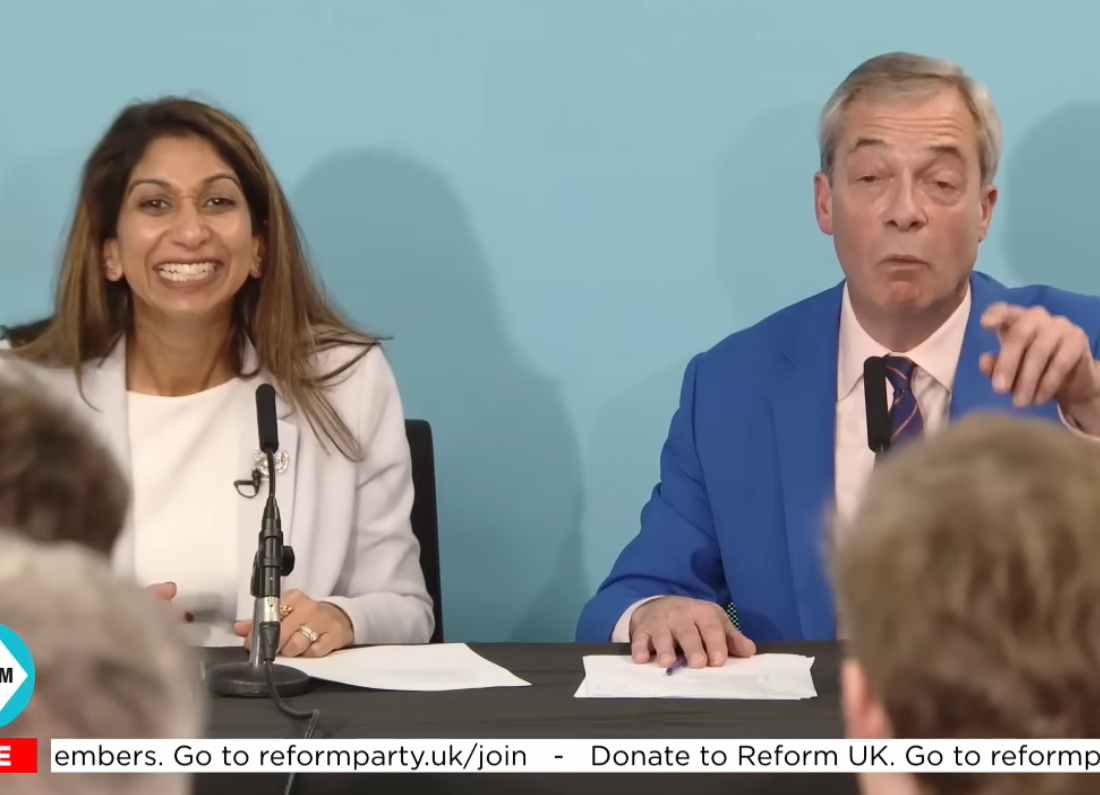
Suella Braverman has revived the argument over who can call themselves English, insisting that being born and raised in England does not make her English because she has Asian ancestry.
The former home secretary, who now represents Reform UK, said she was proud to be British but rejected what she described as the liberal view that anyone born in England could also be English.
Braverman wrote:
“As I’ve said before, I’m not English. I’m proud to be British.”
She said her family had links to Britain stretching back centuries and noted that she was born in England, speaks English, supports the England football team and loves the country.
But she continued:
“Englishness is an ethnicity.”
Braverman argued that accepting somebody as English because they were born in the country amounted to a “laissez-faire, anything-goes” approach to identity.
She accused liberals, including some Conservatives, of being frightened of accusations of racism and therefore believing that “anyone, as long as they’re born here, can be English”.
Braverman says ancestry matters
Braverman was born in Harrow and raised in Wembley. Her mother was born in Mauritius to a family of Indian origin, while her father was born in Kenya and also has Indian ancestry.
She has previously described herself as a “child of the British Empire” and said her parents arrived in Britain with admiration for its institutions.
Her latest comments repeat an argument she made in February 2025, when she wrote that English identity must be rooted in ancestry, heritage and ethnicity rather than residence or fluency.
At the time, she told followers:
“I’m a proud British Asian. And of course, I’m not English. I never thought that was contentious.”
She said she did not feel English because she had no generational connection to English soil. She also questioned whether it would take five or six generations before somebody from an immigrant family could claim the identity.
Braverman is free to describe her own identity as she chooses. The argument becomes more contentious when her personal choice is presented as a rule for millions of other people born and raised in England.
Her latest statement goes further than saying she personally does not feel English. It rejects the right of birthplace, upbringing and participation in English life to provide a route into that identity.
Rishi Sunak called the argument ‘ridiculous’
Rishi Sunak has repeatedly challenged Braverman’s position.
The former prime minister was born in Southampton to parents of Indian heritage who had moved to Britain from East Africa. He describes himself as British, English and British Asian.
Responding to Braverman’s original comments in 2025, Sunak said:
“Of course I’m English. I was born here, brought up here.”
He called her argument “slightly ridiculous” and said it would exclude many of the people who represent England in international sport.
Sunak returned to the subject this week, warning against turning Britishness into a “DNA test”.
As The Daily Britain reported, Sunak said politicians could support lower immigration and demand stronger integration without telling non-white people that they could never truly belong.
He warned that denying somebody’s English or British identity because of their skin colour risked creating a two-tier society.
“We cannot allow race to be reintroduced into our politics,” he wrote.
Braverman’s response does not directly mention Sunak. It does, however, defend precisely the ancestry-based definition he criticised.
Who decides when somebody becomes English?
Braverman’s argument leaves an obvious question: how many generations are enough?
If somebody born in England, educated in England and participating fully in English life is not English, it is unclear when their descendants would qualify.
Braverman acknowledges that she supports the England football team and loves England. Under her definition, those cultural attachments still cannot overcome ancestry.
Sunder Katwala, director of the British Future think tank, has said Braverman is entitled to reject an English identity for herself. He argues that this does not prevent other Britons of Asian, Black or mixed heritage from identifying as English.
British Future has also noted that reluctance to claim English identity was once more common among minority communities, particularly when many felt it was not open to them. That has changed as younger generations increasingly identify with England as their birthplace and home.
English can describe an ethnic heritage. It is also widely used as a national and cultural identity. Those meanings have existed alongside one another for years, including in census responses where people can choose how they describe their nationality and ethnic background.
Braverman wants the ethnic definition to take priority.
Why her position matters politically
Braverman is no longer speaking as a Conservative backbencher.
She defected to Reform UK in January and now serves as the party’s spokesperson for education, skills and equalities. Her comments therefore carry greater significance than a private reflection on her family background.
In her latest statement, Braverman said Britain needed a more “muscular” approach to citizenship and nationality. She claimed multiculturalism had left some people uncertain about the country’s identity and pointed to other nations using ethnicity and culture when deciding who belongs.
She did not announce a new policy or explain how her definition of Englishness would operate in law. British citizenship and English identity are not the same thing, and there is no separate English citizenship.
But her argument draws a firm line. A person can be born here, grow up here and consider England their home, yet still be told that the English identity is not available to them.
That is the distinction Sunak has challenged. Braverman says ancestry protects the meaning of Englishness. Sunak says using ancestry as the deciding factor puts race back into British politics.
The disagreement is no longer over whether Braverman considers herself English. She plainly does not.
It is over whether she gets to make that decision for everybody else. Which she does not.
One response to “‘I’m not English’: Suella Braverman sparks row after defining Englishness by ethnicity”
-
This article is clear that holding the identity is a personal decision, and that her motive is bad in drawing a line across other people that would exclude them. FB sharings of other reports on this story are not being thus clear at all and are taking another dangerous racist position themselves: they are denying her right not to be English and mocking that she said birthplace does not necessarily make you English. That is “birthplace racism”, the school bully + thick yob bigotry of believing birthplace dictates country.
Anne Frank was born in Germany, that fact alone proves this birthplace bigotry Nazi and across that line of offence. The Chagossians and many Native American peoples were made born outside their country by their ousting from it, do they then ease to exist ? The spiral when you apply that to the Israel-Palestine situation becomes impossible, and it is ever since the ancient Jews’ exile in Babylon in Old Testament times that birthplace racism has been visibly wrong. Its wrongness is because parents move around hence some people are attached to different countries than they are born in, and you are excluding them from their countries if you dictate a birthplace identity to them instead. Some folks never have any further connection to their birthplace, e.g. the Silent Twins, Barbadian born in Yemen because their dad was in the RAF there and left there at 8 months old. Recent history caused many Brits to be born in Germany or India or Africa.English – George Orwell, Cliff Richard, Pete Best, Julie Christie, Vivien Leigh, Rab Butler, born in India. Christian Bale born in Wales. Tony Blair born in Scotland. Duke of Wellington born in Ireland. Emma Watson + King Edward IV born in France. John of Gaunt with brother Lionel of Antwerp born in Flanders. Florence Nightingale born in Italy. St Margaret Atheling – English, born in Hungary. Boris Johnson born in America. Doris Lessing born in Iran. Eddie Izzard born in Yemen. Nicholas Courtney born in Egypt. Richard Dawkins born in Kenya. Ernest Rutherford born in New Zealand.
English joinlty with birthplace – Rudyard Kipling born in India. Richard E Grant born in Eswatini.
born in England –
Robert the Bruce, the Queen Mother, Ian Fleming, Rod Stewart, Tilda Swinton, Brigit Forsyth, John Prebble (historian), PMs William Gladstone, Lord Rosebery, Alec Home, and Scottish nats Lesley Riddoch, Craig Murray, Angus Robertson, Mike Russell, Scottish. Lloyd George, Taron Egerton, Plaid Cymru leaders Saunders Lewis + Dafydd Wigley, Welsh. Pop stars Shane MacGowan, Boy George, Phil Lynott, first woman MP Constance Markievicz, Irish. historian Nikolai Tolstoy, Russian. Kiefer Sutherland, Canadian.





Leave a Reply