

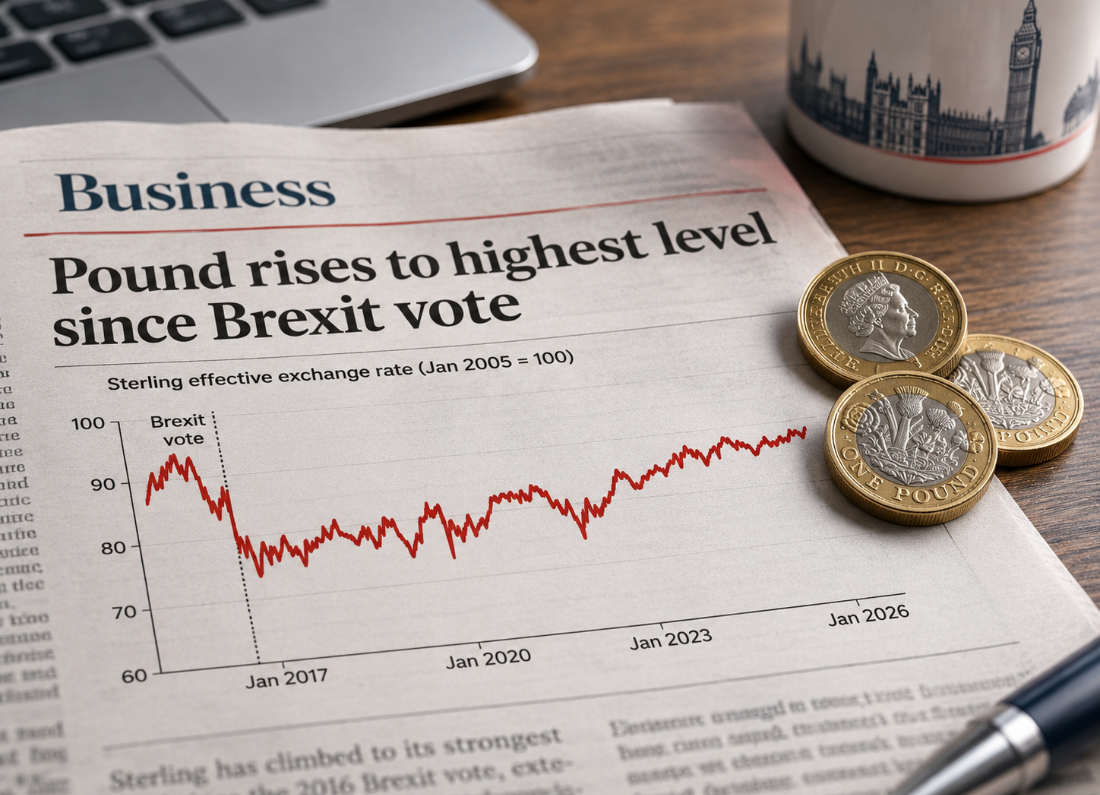
The pound has risen to its highest overall level since Britain voted to leave the European Union more than a decade ago, as stronger-than-expected economic growth and renewed confidence in the UK help sterling recover from years of political and financial turmoil.
Bank of England figures show that the currency’s trade-weighted value reached 86.4 this week, matching its strongest level since the Brexit referendum in June 2016.
The milestone marks a significant recovery for sterling, which suffered a dramatic fall following the referendum and endured further periods of weakness during the Brexit negotiations, the Covid pandemic and Liz Truss’s disastrous mini-Budget in September 2022.
Economists say Britain is now being viewed differently by international investors, with relative political stability, surprisingly resilient economic growth and improving relations with the European Union contributing to the change in sentiment.
But there is another important factor behind the recovery.
Financial markets are anticipating an increase in UK interest rates, with the Bank of England widely expected to raise borrowing costs on Thursday 5 November for the first time in more than three years.
That expectation has made sterling more attractive to some investors, although it also raises the prospect of higher mortgage and borrowing costs for millions of households.
Pound reaches strongest overall level since June 2016
The latest milestone is based on the Bank of England’s sterling effective exchange rate index, which measures the pound’s value against a basket of 18 major currencies.
Unlike the familiar pound-to-dollar or pound-to-euro exchange rates, the index provides a broader measure of sterling’s international purchasing power.
It gives greater weight to currencies according to their importance in Britain’s trading relationships, allowing economists to assess how the pound is performing overall.
This week’s reading reached 86.4, with 100 representing the currency’s value in 2005.
The index is therefore not a measure of the pound being worth 86.4p, nor does it mean sterling is at its highest level ever.
It means the currency has returned to its joint-highest trade-weighted level since the June 2016 referendum.
The Bank of England is expected to confirm the latest official calculation on Thursday.
Sterling has also strengthened against the dollar and euro in recent weeks.
Early on Thursday morning, the pound was trading at approximately $1.3495 against the US dollar and €1.1979 against the euro, according to figures reported by the BBC.
Daily exchange rates can move considerably as investors respond to economic data, central bank announcements and developments overseas.
The broader index provides a better indication of the longer-term recovery.
A remarkable turnaround after the Brexit referendum
The pound’s latest performance is particularly notable because the currency became one of the clearest financial indicators of the economic uncertainty surrounding Brexit.
Sterling fell sharply immediately after the referendum result in June 2016, as investors reassessed Britain’s future trading arrangements and the potential consequences of leaving the world’s largest single market.
The years that followed brought repeated periods of instability.
Negotiations over the withdrawal agreement, disagreements over the Irish border and uncertainty about Britain’s future economic relationship with the EU all influenced investor confidence.
The pandemic created further disruption, while the September 2022 mini-Budget delivered another severe shock.
Under then-prime minister Liz Truss and chancellor Kwasi Kwarteng, a package of unfunded tax cuts triggered turmoil in financial markets, a sharp fall in sterling and a dramatic rise in government borrowing costs.
The Bank of England was forced to intervene in the gilt market after instability threatened parts of the pensions system.
Truss resigned after just 49 days in Downing Street.
The pound’s return to its strongest overall level since the referendum demonstrates how far market sentiment has changed since those events.
However, a stronger currency today does not erase the economic consequences of Brexit, nor does it establish that Britain is better off outside the European Union.
The exchange rate is influenced by a wide range of factors, including the relative strength of other currencies and differences in interest rates.
It is therefore important not to confuse sterling’s recovery with a comprehensive judgement on Britain’s economic performance over the last decade.
Investors point to political stability and closer EU relations
One of the explanations offered by market analysts is that Britain is now benefiting from a more predictable political environment.
The country has experienced years of extraordinary political instability, including frequent changes of prime minister, repeated disputes over Brexit and dramatic changes in economic policy.
International investors generally value consistency, particularly when deciding whether to hold a country’s currency or invest in its financial markets.
The prospect of a more stable economic policy environment can therefore support demand for sterling.
Britain’s improving relationship with the European Union has also been identified as a contributing factor.
After years of confrontation over post-Brexit arrangements, the government has pursued closer cooperation with European partners, including measures intended to reduce trade friction and strengthen diplomatic ties.
Market participants quoted by the BBC suggested that this rapprochement is helping change perceptions of the UK economy.
Closer trading arrangements could potentially improve business confidence and reduce some of the barriers facing exporters and importers.
However, the extent to which improved EU relations have contributed to sterling’s rise cannot be measured precisely from the exchange-rate figures alone.
Political stability and international relations are part of the explanation, rather than proof of a single cause.
Britain’s economy has performed better than expected
The pound’s recovery has also been supported by stronger economic growth than many analysts anticipated.
UK growth during 2026 has exceeded earlier forecasts, challenging expectations that the country would struggle to maintain momentum.
Former Treasury minister and economist Jim O’Neill told the BBC that he was unsurprised by sterling’s rise.
“I’m not surprised. People were, and to a lesser extent, are, underestimating the improving momentum in the UK.”
His comments reflect a growing recognition that Britain’s economic performance has been more resilient than some previous predictions suggested.
Stronger growth can support a currency by making a country more attractive to investors and improving expectations about future economic activity.
But the latest figures also come with important qualifications.
Household confidence has shown signs of weakening as higher energy and fuel costs put renewed pressure on family finances.
The strength of financial markets does not necessarily reflect the experience of households struggling with bills, rents or mortgage repayments.
A stronger pound can signal improved confidence in the economy without guaranteeing that ordinary workers are seeing comparable improvements in their living standards.
Bank of England faces crucial interest rate decision
The immediate focus for financial markets is the Bank of England’s next monetary policy decision on Thursday 5 November.
Its nine-member Monetary Policy Committee is widely expected to raise Bank Rate from 3.75 per cent to 4 per cent.
That would represent the first increase since August 2023.
The expected move follows renewed pressure on inflation, particularly because of rising global energy prices linked to the conflict involving Iran and disruption to international oil and gas supplies.
Official figures show that consumer price inflation rose to 3.5 per cent in September, remaining above the Bank’s 2 per cent target.
Higher interest rates are intended to reduce inflation by making borrowing more expensive and discouraging spending.
They can also support a currency because investors may receive higher returns on sterling-denominated assets.
That helps explain why expectations of a rate increase have contributed to the pound’s recent strength.
However, an interest rate rise would also create difficult consequences for some households and businesses.
Mortgage borrowers on variable-rate deals could face higher monthly repayments, while people refinancing fixed-rate mortgages may find borrowing costs remain elevated.
Businesses seeking loans for investment could also face additional costs.
For savers, higher interest rates can provide an opportunity to receive better returns, although banks do not always pass on increases in full.
The Bank therefore faces a difficult balance between controlling inflation and avoiding unnecessary pressure on economic growth.
Its decision had not been announced at the time of writing.
What a stronger pound means for ordinary households
The benefits of sterling’s rise are potentially significant, particularly for goods and services purchased from overseas.
A stronger pound means British buyers can obtain more foreign currency for each pound they spend.
That can reduce the cost of imported products, including certain foods, electronics, manufacturing components and energy supplies priced internationally.
It can also make foreign holidays more affordable, as travellers receive more euros, dollars or other currencies when exchanging money.
In theory, cheaper imports can help reduce inflation because retailers and businesses face lower costs for products purchased abroad.
However, exchange-rate movements do not translate immediately or proportionately into lower prices on supermarket shelves.
Importers may have fixed contracts, retailers may take time to adjust prices and other costs can outweigh currency movements.
Rising global energy prices, for example, could still push household bills higher even if sterling strengthens.
There can also be disadvantages.
A stronger pound makes British goods more expensive for some overseas customers, potentially creating difficulties for exporters.
Tourism businesses may also find Britain becomes more expensive for foreign visitors.
The overall impact therefore depends on the balance between cheaper imports, more expensive exports and the broader economic conditions facing the country.
A stronger pound is good news, but not the whole economic picture
The latest milestone provides evidence that Britain has regained some of the international financial confidence lost during years of political and economic turmoil.
It also challenges the assumption that sterling would remain permanently weakened after the Brexit referendum.
But the significance should not be exaggerated.
The trade-weighted index has returned to a level last seen in June 2016, not reached an all-time record.
The pound’s strength is also being supported by expectations of higher interest rates, which reflect renewed inflation concerns rather than an entirely positive economic outlook.
For households, the recovery could help with imported prices and the cost of travelling abroad, but it does not automatically mean mortgages, rent, energy bills or everyday expenses will become cheaper.
The next test comes with the Bank of England’s interest rate announcement.
Economists expect policymakers to increase borrowing costs for the first time in more than three years as they respond to persistent inflationary pressure.
For now, the Bank’s currency index provides a significant economic landmark: more than ten years after the Brexit referendum sent sterling sharply lower, the pound has returned to its strongest overall level since that vote.
The challenge for the government will be ensuring that improved confidence in the currency is eventually reflected in the finances of ordinary households.


Leave a Reply