

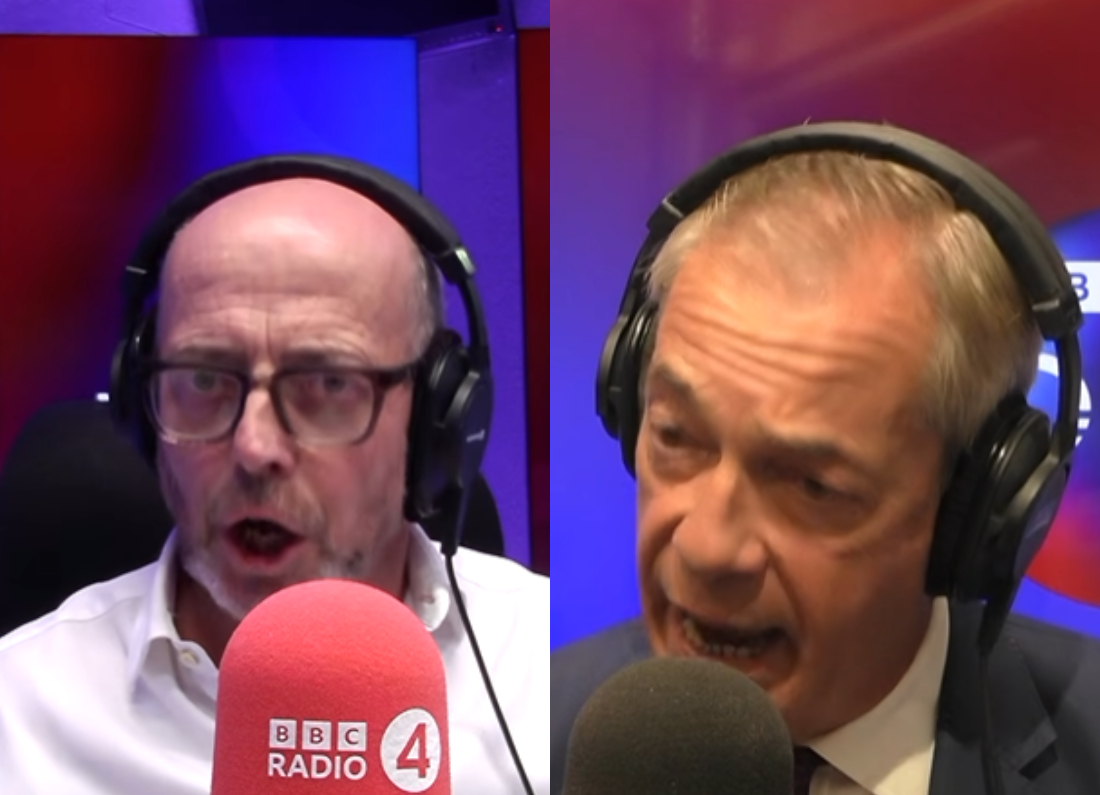
Nigel Farage became embroiled in a heated confrontation with BBC presenter Nick Robinson after being challenged over racist remarks made by a former Reform UK councillor, the party’s candidate vetting and its reliance on wealthy donors with overseas connections.
The Reform leader appeared on Radio 4’s Today programme on Tuesday morning to discuss Brexit, his party’s economic proposals and Prime Minister Andy Burnham’s plans for closer relations with the European Union.
But the interview developed into a sustained examination of Reform’s recent controversies, with Robinson questioning why a councillor who was filmed describing Britain as “infested” with Asian families had chosen to join Farage’s party.
Robinson suggested that the councillor might have regarded Reform as a place where such views would be accepted.
Farage reacted angrily.
“That is absolute cobblers and you know it,” he told the presenter.
The exchange came after Farage had already been challenged over new figures suggesting nearly 80 per cent of Reform’s donations during a recent reporting period came from individuals or companies with recent overseas connections.
He also faced questions about why former Conservative ministers who oversaw policies he now condemns have been welcomed into senior positions within Reform.
Robinson confronts Farage over ITV racism investigation
The most heated section of the interview came when Robinson turned to ITV’s recent undercover investigation into Reform UK.
The documentary exposed racist and extremist remarks by several individuals associated with the party, alongside serious questions about how prospective candidates were being vetted.
One of those featured was Alan Feeney, a former Conservative councillor who joined Reform and served as deputy mayor of Solihull.
Undercover footage recorded Feeney describing the country as “infested” with Asian families, remarks that prompted condemnation and his departure from the party.
Robinson questioned whether Reform’s vetting procedures were robust enough to prevent people holding such views from becoming candidates.
He referred to footage showing an undercover reporter posing as a prospective candidate and telling a party official that he supported Tommy Robinson and had liked his social media posts.
Rather than warning the applicant against extremist associations, the official was filmed advising him to delete the posts, create a new account and avoid mentioning them because Farage would be unhappy.
Farage argued that supporting or liking something posted by Tommy Robinson should not automatically disqualify somebody from standing for election.
“I wouldn’t ban anybody for liking someone like Tommy Robinson. Wouldn’t be my cup of tea, but I wouldn’t ban anybody from doing so,” he said.
He subsequently qualified his position, saying the acceptability of liking a particular post would depend on its content.
The Reform leader insisted that his party vetted council candidates more thoroughly than its political rivals.
Robinson challenged that claim, pointing out that the ITV footage appeared to show somebody advising an applicant how to conceal their online activity rather than properly scrutinising it.
‘Because he thought he was amongst friends?’
The disagreement became particularly confrontational when Robinson raised Feeney’s remarks about Asian families.
Farage attempted to distinguish Feeney from candidates who had joined Reform directly, pointing out that he had previously been a Conservative councillor.
Robinson wanted to know why somebody holding such views would have decided to switch parties.
“Why did he join Reform?” the presenter asked.
“Because he had more chance of winning his seat,” Farage replied.
Robinson then offered a much more uncomfortable possibility.
“Because he thought he was amongst friends. Do you not think?”
Farage rejected the suggestion immediately.
“No. That is absolute cobblers and you know it.”
The exchange was striking because Robinson was asking about the political environment within Reform, rather than merely whether the party had formally approved Feeney’s comments.
Farage’s position was that Feeney had moved parties for electoral reasons and that his previous Conservative membership demonstrated the limits of any attempt to associate his views specifically with Reform.
Robinson’s questioning raised a different issue: whether the party’s public rhetoric and internal culture might attract individuals with views its leadership claims to oppose.
Reform has condemned racism and says it has taken disciplinary action following the ITV investigation.
Nevertheless, the undercover footage has placed the party’s candidate selection and vetting procedures under renewed scrutiny.
Farage disputes figures showing reliance on overseas-based donors
Earlier in the interview, Robinson had challenged Farage over a new investigation into Reform’s finances.
Analysis published by The Independent on Tuesday found that approximately 79.4 per cent of donations received by Reform in the 2025-26 reporting period came from individuals or companies with recent overseas connections.
The newspaper identified £23.4 million associated with donors who had been based abroad during the previous two years, compared with approximately £7.22 million from other sources.
The analysis was based on Electoral Commission records and included donors who were eligible to give money under existing UK electoral law.
It did not allege that the donations were illegal.
Robinson nevertheless questioned why a party presenting itself as a champion of British patriotism depended so heavily on wealthy people with links to other countries.
Farage disputed the description of the figures.
“No, no, no, no, no, no, no. That’s just completely wrong,” he protested.
He argued that the newspaper had misunderstood how internationally active businesspeople live, work and maintain connections with Britain.
Robinson emphasised that he was not accusing the party of receiving unlawful foreign donations.
Instead, he asked why such a substantial proportion of Reform’s income came from people who had recently been based overseas.
Farage responded by joking that he could sell peerages or seek financial support from trade unions, referring to controversies surrounding funding arrangements associated with other parties.
But Robinson continued to press the underlying question.
“Why don’t you get money from people who live here?” he asked.
Farage maintained that his donors were British voters and successful international entrepreneurs.
“There are British patriots living and working all over the world,” he said.
The Independent’s analysis did not include the two £36 million donations made to Reform in September by cryptocurrency entrepreneurs Christopher Harborne and Ben Delo, because those payments fell outside the period examined.
Farage’s Brexit criticism comes back to haunt his own frontbench
The interview also examined the increasingly awkward relationship between Reform and former Conservative ministers.
Farage insisted that Brexit remained a success because it had restored Britain’s independence and democratic control over its laws.
But Robinson reminded him that he had previously said Brexit had failed, prompting the Reform leader to distinguish between the referendum result and the way Conservative governments subsequently implemented it.
Farage argued that the Conservatives had failed to use their new powers to reduce immigration.
He accused the governments that followed the referendum of allowing large numbers of people from outside the European Union to enter Britain, undermining one of the central expectations of Leave voters.
Robinson then pointed to an obvious difficulty with that argument.
Robert Jenrick, now Reform’s Treasury spokesman, had previously served as immigration minister under the Conservatives.
Suella Braverman, now a senior figure in Reform, had served as home secretary.
Both had been involved in the governments Farage was blaming for failing to deliver Brexit.
Robinson also referred to previous comments by Zia Yusuf, who had condemned senior Conservative ministers as people who betrayed the country and should never be allowed to take control again.
If those ministers had been responsible for the failures Farage condemned, Robinson asked, why were they now being presented as credible members of a future Reform government?
Farage argued that Jenrick and Braverman had recognised the failures of their party and resigned from ministerial office.
He described that as evidence of integrity rather than a reason to exclude them from Reform.
But the exchange highlighted a central tension in the party’s current political pitch: it condemns the record of previous Conservative administrations while recruiting some of the politicians who helped run them.
‘Do you see Brexit objectively as a success?’
Robinson’s questioning began with Farage’s claim that Brexit would never have happened without his involvement.
The Reform leader described himself as the father of the movement that led Britain out of the European Union, arguing that he had spent years campaigning for an outcome the political establishment had considered impossible.
Robinson asked whether, ten years after the referendum, he regarded Brexit as an objective success.
“Yes, I do,” Farage replied.
He argued that Britain had gained greater international independence, maintained a strong financial services industry and developed trading opportunities beyond the European Union.
But Robinson pointed out that Farage had previously used the phrase “Brexit has failed”, challenging him over the apparent contradiction.
Farage said he had been referring to the disappointment felt by voters who had expected immigration to fall after Britain left the EU.
He maintained that leaving the bloc had provided the powers necessary to control immigration, but that Conservative governments had failed to use them effectively.
The discussion then turned to Burnham’s suggestion that Britain should reconsider aspects of its relationship with the European Union.
Farage accused the Prime Minister of preparing to abandon commitments made to voters by Labour.
He argued that reopening discussions about freedom of movement would amount to a betrayal of those promises and called for a general election if Burnham intended to pursue such a fundamental change.
Robinson challenged Farage’s suggestion that merely debating a closer relationship with Europe was illegitimate.
He argued that, ten years after the referendum, Britain was entitled to reconsider its economic relationship with its largest trading partners.
The presenter pointed to concerns from employers and business organisations about labour shortages and barriers to economic growth.
Farage rejected the argument, insisting that freedom of movement primarily benefited large businesses seeking cheaper labour.
Robinson questions whether Reform’s support is slipping
The presenter also raised Reform’s declining position in national opinion polls.
Farage acknowledged that his party had lost some support in recent months but insisted that its core voters remained loyal.
He blamed part of the decline on what he described as a relentless media and establishment assault on Reform.
Robinson pointed out that the party had fallen from its previous position at the top of the polls and asked Farage what lessons he had drawn from its recent difficulties.
The Reform leader suggested that some voters had temporarily moved towards Restore, a rival political movement, but argued that they would be unlikely to remain there by the next general election.
He maintained that a campaign fought over Europe and immigration would favour Reform, particularly if Burnham continued discussing closer ties with the EU.
Farage also defended the party’s wider electoral prospects despite criticism of its funding arrangements and the recent ITV investigation.
Two uncomfortable interviews in one morning
Farage’s confrontation with Robinson followed another difficult appearance on BBC Breakfast earlier on Tuesday.
During that interview, Sally Nugent repeatedly challenged him over his ally Raheem Kassam’s description of Conservative leader Kemi Badenoch as a “Nigerian scammer”.
Farage initially attempted to distinguish between the words used before eventually acknowledging that the remark was excessive while denying it was intentionally racist.
The Radio 4 exchange brought a different set of questions about Reform’s internal culture, candidate vetting and dependence on wealthy donors.
Both interviews also examined Farage’s claim that he offers a credible alternative to the political establishment, testing his party’s current positions against its own record and the backgrounds of its senior figures.
On Radio 4, Farage maintained that Reform’s vetting was stronger than that of other parties and that his donors were patriotic British people entitled to contribute to political debate.
Robinson continued to question those claims, finishing with the apparent contradiction between Reform’s recruitment of Feeney and the racist remarks he was subsequently filmed making.
Farage insisted that the former councillor had joined his party because he believed it offered a better chance of winning an election.
When Robinson suggested he might instead have felt comfortable among like-minded people, the Reform leader offered his clearest response of the interview.
“That is absolute cobblers and you know it.”
3 responses to “‘Absolute cobblers!’: Farage clashes with Nick Robinson over racism and Reform’s overseas donors”
-
How anyone with a modicum of common sense can support farage and his private company reform uk limited . Hes financed by dubious donors hes threatened to sue everybody and their granny and never has because he knows some of the dubious donors would be called to give evidence under oath and that would be a best seller .
-
Please someone tell me how a man from Thailand who’s one of Farages donors his in Farages words a British Voter
One last thing wouldn’t it be a good idea to stop any donations for any party and instead be funded by the country and the party’s instead -
FASCIST FARAGE KEEPING A BRAVE FACE ON IN A DESPERATE SITUATION ….. HE KNOWS THERE MORE TO COME …!!!!!



Leave a Reply