

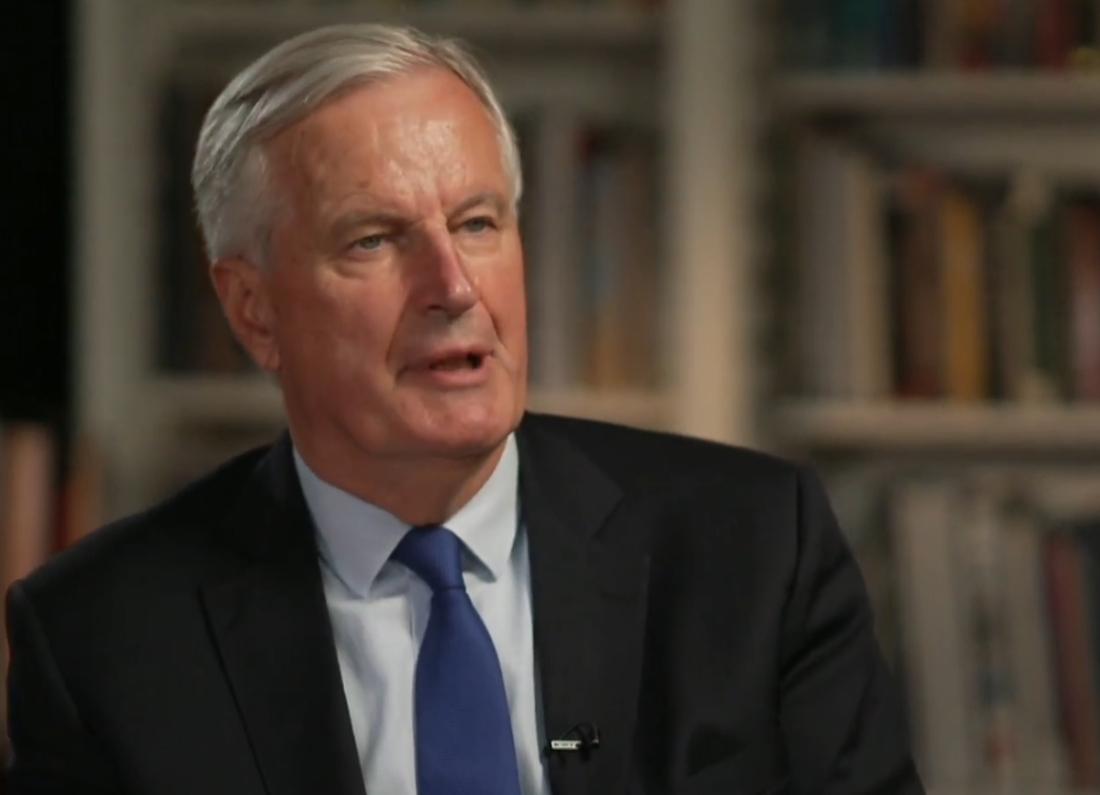
Britain could negotiate its way back into the European Union without being forced to abandon the pound, according to Michel Barnier, the man who led Brussels’ Brexit negotiations with the UK.
The former French prime minister and European Commission chief negotiator has suggested that Britain could secure an exemption from adopting the euro if a future government decided to seek EU membership again.
His intervention challenges one of the arguments repeatedly raised by Nigel Farage and other Brexit supporters, who have warned that rejoining would mean surrendering Britain’s currency and adopting the euro.
Speaking to Sky News presenter Cathy Newman, Barnier said it would be possible to begin negotiations on a new membership arrangement without accepting an automatic commitment to join the single currency.
But the former Brexit negotiator also delivered a warning that will be considerably less welcome to those hoping Britain could return to the benefits of EU membership without reversing its immigration arrangements.
The free movement of people, goods, services and capital would have to be accepted together.
Britain, he insisted, would not be allowed to choose which parts of the single market it wanted while rejecting the rest.
The remarks come as Prime Minister Andy Burnham seeks a closer trading and diplomatic relationship with Brussels, and as the question of whether Britain should eventually reverse Brexit returns to the political debate.
Barnier challenges claims Britain would have to abandon sterling
Barnier was asked whether the UK could realistically rejoin the European Union while keeping the pound.
Under the EU’s existing framework, new member states are generally required to commit to adopting the euro once they meet the necessary economic and legal conditions.
Denmark is the sole member state with a formal treaty opt-out from the single currency.
Britain previously enjoyed its own exemption, allowing it to remain in the European Union while retaining control over monetary policy through the Bank of England.
That arrangement ended when the UK left the bloc in January 2020.
But Barnier believes a future membership agreement could potentially accommodate a similar arrangement.
Speaking to Sky News, he said it was “perfectly possible to begin such a negotiation” without an obligation to participate in the euro.
He went further, suggesting that the UK could negotiate a new relationship excluding the requirement to adopt the single currency.
His comments are significant because of his central role in the original Brexit process.
Barnier led negotiations on behalf of the European Union from 2016 to 2021, working directly with successive British governments as the two sides attempted to establish the terms of Britain’s departure and future trading relationship.
He is therefore familiar with the legal and political obstacles that would face any attempt to reverse Brexit.
However, he was speaking as a former negotiator, not announcing an agreed position on behalf of the European Commission or the EU’s 27 member governments.
The existing EU rules still require euro adoption
There is an important qualification to Barnier’s remarks.
Current EU rules state that member countries, with the exception of Denmark, are expected to adopt the euro once they satisfy the conditions for joining the eurozone.
Those conditions include requirements relating to inflation, public finances, interest rates and exchange-rate stability.
There is no fixed timetable requiring every member to adopt the currency immediately after joining.
Several EU countries, including Poland, Sweden, Czechia, Hungary and Romania, continue to use their national currencies.
But not having adopted the euro is different from possessing a permanent exemption from the obligation to do so.
Denmark’s negotiated opt-out is written into the EU treaties.
For Britain to secure an equivalent guarantee on rejoining, other member states would have to accept the necessary legal arrangements during accession negotiations.
That would not be automatic.
The accession process requires the agreement of existing EU members, and an eventual membership treaty would need approval and ratification through the relevant procedures.
Barnier’s intervention therefore establishes that a former senior EU negotiator believes an exemption could be negotiated.
It does not establish that the EU has already agreed to grant one.
Nevertheless, the remarks complicate the argument that rejoining would inevitably require Britain to replace sterling with the euro.
No return to the single market without freedom of movement
If Barnier offered flexibility on the pound, he was much less accommodating when it came to the single market.
He insisted that the European Union would not allow Britain to regain access to the full benefits of membership while refusing the obligations that accompany them.
The EU single market operates around four fundamental freedoms: the movement of goods, services, capital and people.
Barnier made clear that these principles cannot be separated according to a country’s political preferences.
He told Sky News that there could be no negotiations over selective participation in the single market.
The position closely resembles the one he adopted during the original Brexit negotiations, when successive British governments sought arrangements that would preserve significant economic advantages while ending free movement.
The EU rejected those proposals where they conflicted with the basic operation of the single market.
The same difficulty would arise if a future British government attempted to return.
Rejoining the European Union would mean accepting free movement rights for EU citizens, as well as the corresponding rights of British citizens to live and work across the bloc under applicable EU rules.
That would represent a major political reversal from the immigration arrangements introduced after Brexit.
For those seeking closer trade without full membership, the practical options would depend on what Britain and Brussels could negotiate.
But Barnier’s message on full single-market participation was unmistakable: Britain could not return on an entirely self-selected set of terms.
Nigel Farage’s euro argument faces fresh scrutiny
The remarks are likely to intensify the debate between those who want to reverse Brexit and politicians determined to keep Britain outside the European Union.
Nigel Farage has long presented control over British laws, borders and money as fundamental reasons for leaving the bloc.
The possibility of Britain being required to adopt the euro has also featured in arguments against rejoining.
Barnier’s intervention provides a challenge to the idea that giving up sterling would necessarily be a condition of returning.
If a permanent exemption could be secured, the UK might be able to participate in European political and economic institutions while retaining its own currency.
That would remove one of the most politically sensitive obstacles to reversing Brexit.
But it would not resolve the wider argument about sovereignty.
EU membership would involve accepting the authority of European institutions in areas governed by EU law, contributing to the bloc’s budget and participating in its common decision-making arrangements.
It would also require a fresh political agreement between Britain and existing member states.
The free movement question would remain particularly difficult for politicians who have built their approach to Brexit around tighter immigration controls.
Barnier’s position therefore presents both an opportunity and a challenge to supporters of rejoining.
The currency question may be more flexible than some campaigners have suggested, but the central principles of the single market are not.
Barnier welcomes Burnham’s closer relationship with Brussels
The interview comes as Andy Burnham’s government seeks to improve Britain’s relationship with the European Union.
Burnham has acknowledged the economic damage caused by the existing Brexit arrangements and signalled that he wants a closer partnership with Brussels.
His government has been pursuing measures aimed at reducing barriers to trade and increasing cooperation in areas where Britain and the EU share interests.
Barnier welcomed that approach.
He told Sky News that he had listened carefully to Burnham’s comments at the Labour Party conference and supported efforts to improve the relationship.
The former negotiator highlighted areas including artificial intelligence, foreign policy, intelligence and defence as opportunities for greater cooperation.
His comments suggested that a substantial improvement in UK-EU relations could take place without an immediate decision about rejoining either the single market or the European Union itself.
That distinction matters because closer trading and diplomatic arrangements are not necessarily equivalent to full EU membership.
A government can negotiate cooperation agreements while remaining outside European institutions, although the nature and depth of those arrangements depend on what both sides are willing to accept.
Barnier’s remarks also demonstrate that there is interest in rebuilding relations from politicians who were directly involved in Britain’s departure.
The political decision would still belong to Britain
Despite discussing the possibility of rejoining, Barnier stopped short of urging the UK government to begin an application.
He said the question of seeking EU membership again was ultimately a matter for the British people.
Any formal application would require a political decision by the UK government, followed by negotiations with European institutions and individual member states.
There is no automatic right for a former member to return under its previous terms.
Nor would the UK necessarily be able to recover every exemption and privilege it held before leaving.
The euro opt-out is a particularly important example.
Barnier believes an exception could be negotiated, but the decision would belong to the EU’s existing members as part of a wider accession settlement.
Similarly, restoring free movement would require a substantial political debate in Britain about immigration, employment, public services and the rights of British citizens in Europe.
Supporters of rejoining argue that membership could reduce trade barriers, improve economic opportunities and restore freedoms lost through Brexit.
Opponents believe the costs to national decision-making and immigration control would outweigh those benefits.
Barnier’s comments do not settle that argument.
What they do is challenge one assumption that has featured prominently in it.
A significant intervention, but not a membership offer
More than a decade after the referendum, the question of Britain’s future relationship with the European Union remains unsettled.
The government is seeking closer cooperation, exporters continue to confront barriers created by Brexit, and public debate increasingly includes questions about whether Britain should eventually rejoin.
Barnier’s intervention is important because it comes from someone who understands how difficult the original negotiations became.
He has suggested that the pound need not be an insurmountable obstacle to membership.
But he has also reiterated the principle that dominated the Brexit talks: Britain cannot expect unrestricted access to the single market while rejecting the freedom of movement on which it is built.
The two points must be considered together.
An exemption from the euro may be negotiable, subject to agreement from existing EU members.
An exemption from the core freedoms of the single market, according to Barnier, is not.
For Farage and other opponents of rejoining, that leaves the immigration and sovereignty arguments firmly in place.
For those hoping Britain might one day reverse Brexit, it opens the possibility of returning without surrendering sterling.
Whether that possibility ever becomes a real offer will depend on decisions made in London and across the European Union.
Barnier, for his part, has made clear that he welcomes Burnham’s efforts to rebuild the relationship, while leaving the decision about membership to the British public.


Leave a Reply