

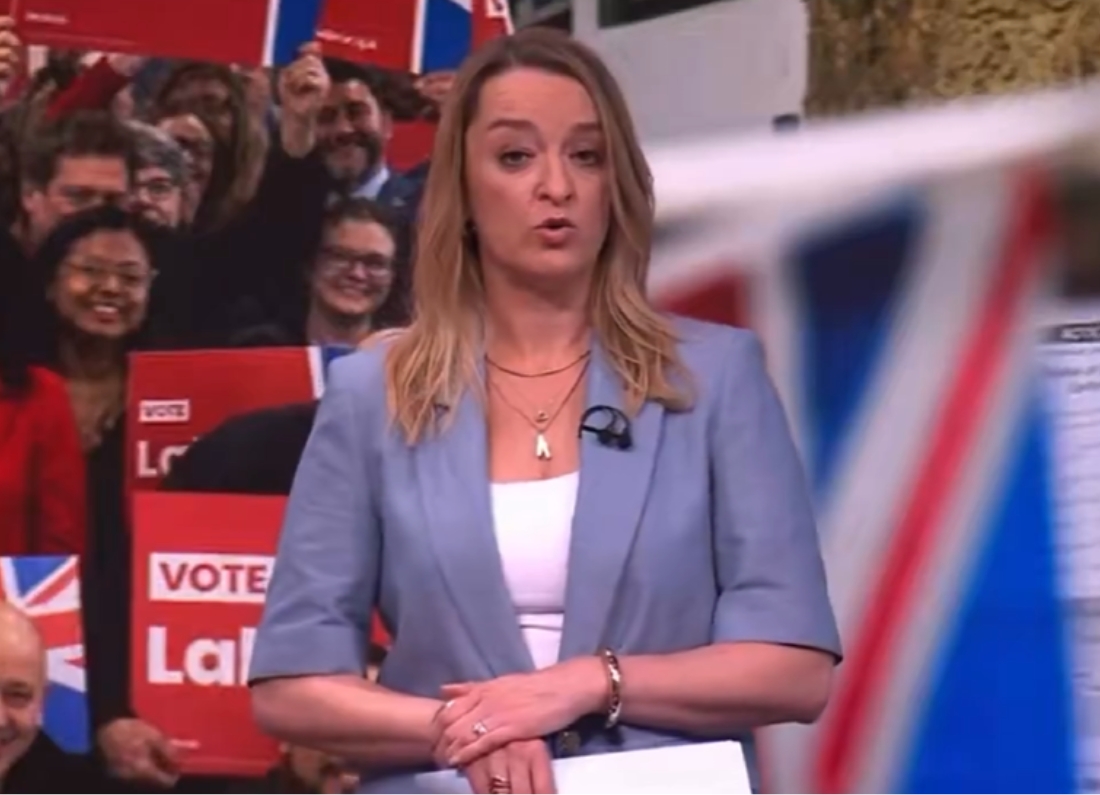
BBC presenter Laura Kuenssberg has revealed that a government minister may have attempted to proposition her for a threesome after inviting her to a hotel room during a political party conference.
The former BBC political editor said she had been expecting a routine professional meeting with the politician and one of his advisers, only to arrive and discover him lying across a bed with several buttons of his shirt undone and his partner beside him.
Kuenssberg described the encounter as deeply uncomfortable, explaining that she quickly finished her drink before leaving the room.
Asked directly whether she believed the minister and his partner had wanted her to join them in a sexual encounter, she admitted the thought had crossed her mind, although she was careful not to claim that she knew their intentions.
The revelation emerged during an interview with The Times ahead of the publication of her new book, Pay Attention, in which she reflects on more than two decades reporting on British politics.
It was not the only unsettling encounter she described. Kuenssberg also recalled being subjected to unwanted physical contact by another minister and receiving inappropriate attention from other senior political figures.
An unexpected encounter at a party conference
Kuenssberg’s account began with what she believed would be an ordinary meeting during a political party conference.
Journalists covering Westminster regularly speak to ministers and their advisers away from formal interviews, particularly at party conferences where politicians, staff and reporters often stay in the same hotels.
Such meetings can provide opportunities to discuss government policy, political developments and stories that may not emerge during public press conferences.
Kuenssberg said she had arranged to meet the unnamed minister and expected his adviser to be present.
Instead, she found the politician lying on the hotel bed with his shirt partly unbuttoned, accompanied by his partner.
The circumstances immediately made her uncomfortable.
She stayed only long enough to finish her drink before leaving.
Speaking to The Times, Kuenssberg was asked whether she thought the couple might have intended to invite her into a threesome.
“Well, maybe they were and maybe they weren’t. As I say, maybe they weren’t and I got it completely wrong. It was very uncomfortable.”
Her answer leaves an important distinction between what she says she witnessed and what the minister may have intended.
Kuenssberg has not claimed to know for certain that she was being propositioned, and there is no independently established account of the unnamed politician’s intentions.
Nevertheless, she clearly regarded the situation as inappropriate for the professional meeting she had expected.
Who was the minister?
Kuenssberg has declined to identify the politician involved, and has not disclosed which party conference the encounter took place at.
That has inevitably encouraged speculation, given the number of senior politicians she has interviewed throughout her career.
However, she has provided no evidence publicly identifying the minister, and there is no reliable basis for attributing the incident to any particular individual.
The journalist also cautioned against assuming that the politician was a Conservative simply because of the political periods she has covered.
During her career, Kuenssberg has reported on governments led by both Labour and the Conservatives, covering some of the most consequential political events of the past two decades.
She became the BBC’s first female political editor in 2015 and held the position until 2022, when she moved to presenting the broadcaster’s flagship Sunday morning political programme.
The hotel room story is one of several personal experiences she has now chosen to discuss as part of her reflections on working at the centre of British politics.
Another minister allegedly groped her
Kuenssberg also described a separate incident involving a married government minister whom she had previously met for coffee to discuss politics.
According to her account, the politician invited her to the theatre before making an unwanted physical advance.
She described the contact as “a little grope” and said she subsequently stopped communicating with him.
The minister was not identified.
In another example, Kuenssberg recalled a former minister who repeatedly kissed her on the head whenever they met.
She described his behaviour as strange, although she said she had not felt personally threatened by it.
“That was just weird. I never felt threatened. But it’s just a strange thing to do.”
She also described receiving a message from a peer complimenting the clothes she wore on television, which she regarded as creepy.
While the circumstances differed between the incidents, they illustrated a recurring problem for women working in political journalism: professional relationships becoming blurred by unwanted personal attention.
Kuenssberg’s accounts also demonstrate why apparently informal meetings can become uncomfortable when a politician behaves in a way that the journalist neither anticipated nor welcomed.
Concerns about younger people working in Westminster
The BBC presenter said her experiences had left her concerned about the treatment of people beginning their careers in politics and political journalism.
Westminster is a workplace where power and influence are concentrated among a relatively small group of politicians, advisers, officials and journalists.
Senior figures often have the authority to influence careers, while younger employees may find it difficult to challenge inappropriate behaviour.
Kuenssberg suggested that the problem had not disappeared despite increased attention to workplace misconduct.
“There is still a concern in Westminster that particularly young people starting out are sometimes very vulnerable.”
Her comments reflect longstanding questions about Westminster’s working culture, including the blurred boundaries created by networking events, late-night meetings and professional relationships dependent on access to influential politicians.
The issue has been examined repeatedly in parliamentary reviews and investigations into bullying and harassment.
However, Kuenssberg’s latest remarks are not presented as a formal complaint against any named individual.
Instead, they form part of her broader account of the environment in which political journalists work, and the personal experiences which rarely feature in their published reporting.
‘I’m not friends with politicians’
Kuenssberg also addressed perceptions that political journalists become too close to the people they cover.
Her access to senior politicians, including prime ministers and party leaders, has frequently prompted criticism from viewers who believe some broadcasters treat particular political figures too sympathetically.
But she rejected the suggestion that her professional relationships amount to personal friendships.
“I’m not friends with politicians. There are lots of politicians who are perfectly nice people, but I don’t socialise with politicians.”
The distinction is an important one for political reporters whose work depends on asking questions of people they may have known professionally for years.
Kuenssberg has covered successive Conservative and Labour leaders, the Brexit referendum, the collapse of multiple governments and the emergence of Reform UK as a significant political force.
Her book examines how that political environment has changed during her career, particularly through social media, the breakdown of established party loyalties and the increasingly confrontational relationship between politicians and journalists.
She also discusses the abuse she has received online, which has at times been serious enough for the BBC to provide security protection.
New book examines the changing world of British politics
Pay Attention is Kuenssberg’s first book and brings together her experiences covering some of Britain’s most turbulent political years.
She has explained that she wanted to examine how the country reached its current political position, from the Brexit referendum and the upheaval that followed to the growth of Reform UK and increasingly polarised public debate.
The book also explores the relationship between journalists and political power, a subject made particularly relevant by the encounters she has described.
Throughout the interview with The Times, Kuenssberg was candid about behaviour she considered inappropriate while declining to identify the ministers responsible.
The hotel room episode has understandably attracted attention because of the circumstances she described and the possibility that the politician and his partner were seeking a sexual encounter.
But her account also included an explicit acknowledgement of uncertainty.
She does not know what the minister intended, and accepts that she may have misread the situation.
What she does know is that she arrived expecting a professional discussion, found herself in circumstances she had not anticipated and wanted to leave.
As she told The Times, whatever the couple had intended, the experience was “very uncomfortable”.


Leave a Reply