

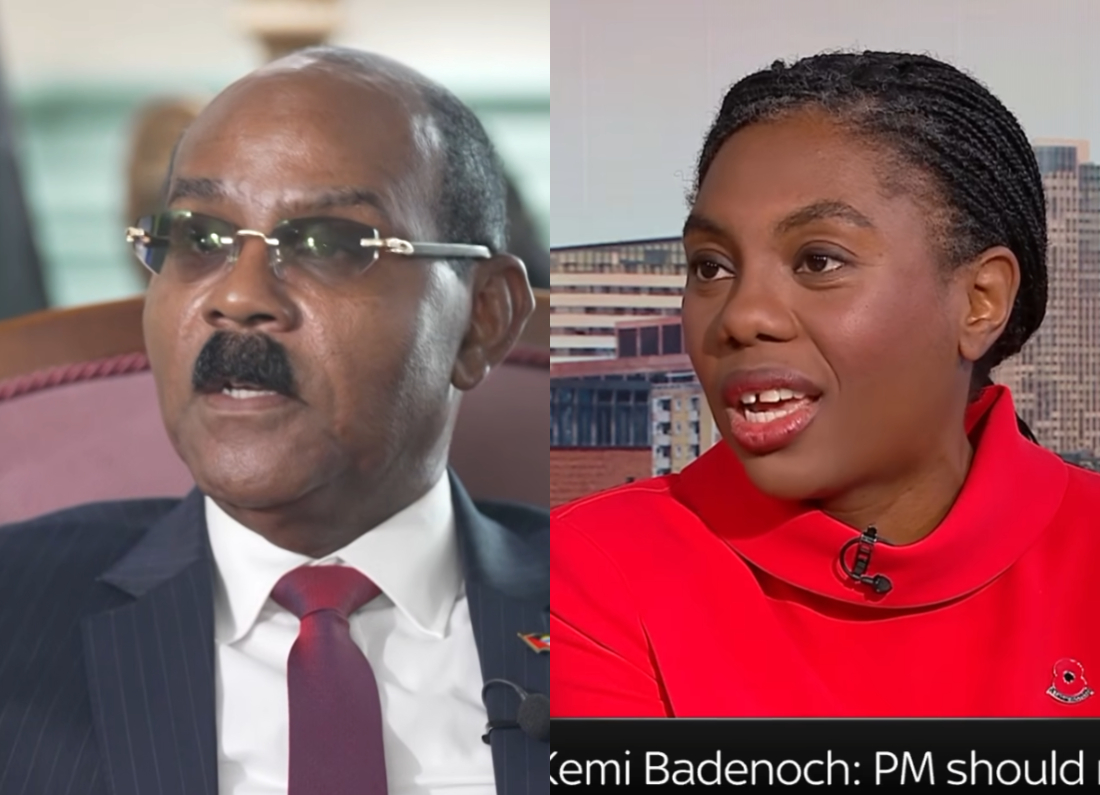
Kemi Badenoch has been sharply criticised by the Prime Minister of Antigua and Barbuda, who declared it was “no wonder” the Conservative leader was not running Britain after she dismissed calls for further apologies and reparations over the transatlantic slave trade.
Gaston Browne made the comments during an interview with ITV News as his country prepares to host Commonwealth leaders, including Prime Minister Andy Burnham and King Charles, for a summit where Britain’s historical involvement in slavery is expected to dominate discussions.
The Caribbean leader was responding to Badenoch’s suggestion that Commonwealth countries were using the gathering to seek what she described as “global welfare” from Britain.
He rejected that characterisation, accusing the Conservative leader of misunderstanding the importance of acknowledging historical injustices and providing meaningful compensation.
“Well, I think she’s misguided,” Browne said.
“And no wonder she is the leader of the opposition and not the Prime Minister. Right?”
His intervention comes as Burnham has signalled that his government is prepared to discuss a formal apology for Britain’s involvement in the slave trade, although he has ruled out making British taxpayers financially responsible for reparations.
For Browne and other Caribbean leaders, that distinction leaves the central argument unresolved.
‘No wonder she is the leader of the opposition’
The exchange followed comments Badenoch made ahead of the Commonwealth Heads of Government Meeting in Antigua and Barbuda.
The Conservative leader argued that Britain should stop apologising for historical events and concentrate instead on building a modern relationship with Commonwealth countries.
She suggested that discussions about the slave trade were increasingly being used to demand financial compensation from the United Kingdom.
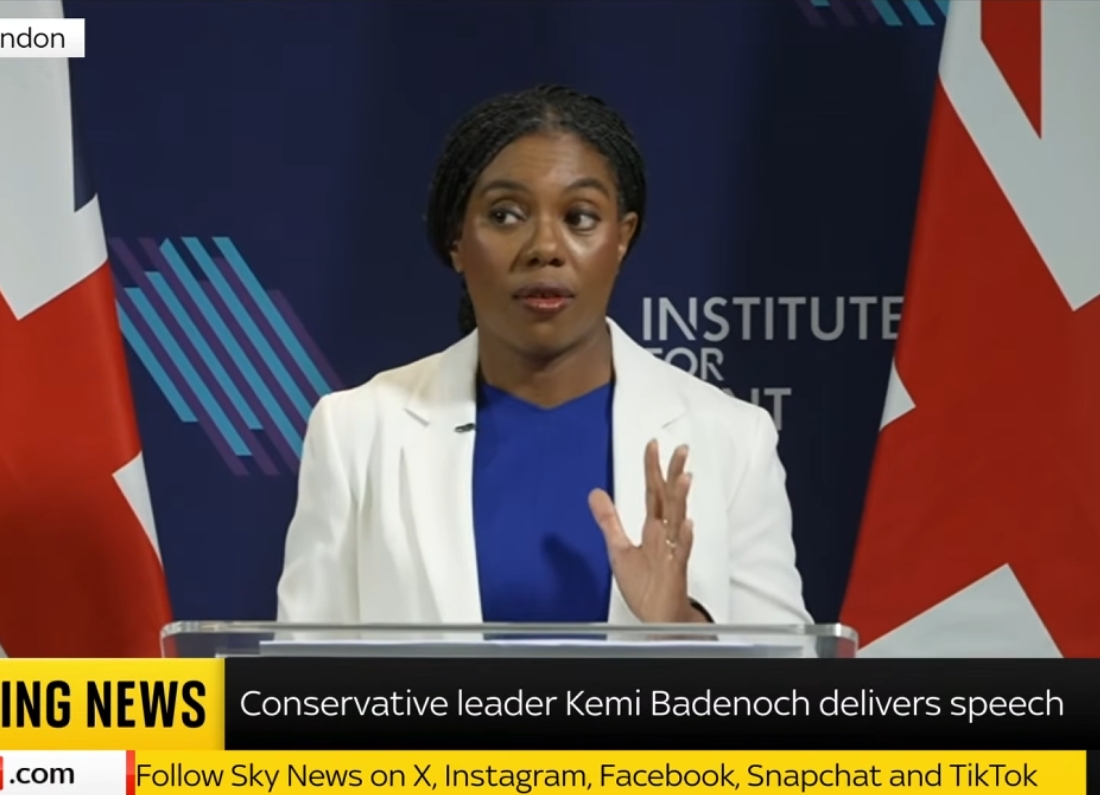
Speaking to Sky News, Badenoch said the gathering risked becoming another occasion for countries to ask Britain for money because of its historical involvement in slavery.
She argued that political leaders should focus on the future rather than repeatedly revisiting past wrongs.
“I don’t think we should be giving any money to compensate people for the slave trade,” she said.
Badenoch also warned that an apology from Burnham could create pressure for financial reparations.
But Browne rejected the suggestion that acknowledging Britain’s role in slavery was simply an attempt to obtain money.
Questioned by ITV News royal editor Chris Ship, he said the Conservative leader’s position was misguided.
He added that it was unsurprising she was in opposition rather than Downing Street.
Asked whether Badenoch should reconsider her stance, Browne declined to give her direct advice.
“Well, that’s up to her. But we do not share her sentiments.”
Burnham offers to discuss an apology but rules out compensation
The disagreement follows a significant shift in the British government’s public approach to slavery and the Commonwealth.
Burnham has said he is open to discussing a formal apology on behalf of the British state for its involvement in the transatlantic slave trade.
Previous British governments have expressed regret and acknowledged the suffering caused by slavery, but none has issued the formal apology now being considered.
Writing ahead of the Commonwealth summit, Burnham proposed a structured dialogue with countries and communities affected by the trade.
He said listening to calls for an apology would form an important part of the discussions.
However, the Prime Minister also made clear that he was not prepared to commit public money to reparations.
Burnham argued that British people living today should not be held personally financially responsible for historical crimes committed under different laws and in a different era.
His approach therefore attempts to separate historical acknowledgement from financial liability.
Chancellor John Healey has defended that distinction, saying an apology could be appropriate without requiring the government to accept demands for compensation.
But the position has attracted criticism from Caribbean leaders who believe reparations are an essential part of confronting the lasting consequences of slavery.
For them, recognition without restitution would leave the material legacy of the transatlantic trade largely untouched.
Antigua’s Prime Minister says compensation is essential
Browne welcomed the possibility of Britain acknowledging its historical responsibility but insisted that financial reparations must remain part of the conversation.
He acknowledged the political difficulties facing any British prime minister considering payments connected to the slave trade.
“I understand the politics in the UK, in which it may be a difficult proposition for him to agree to any form of reparations, but that does not negate the need for reparations.”
The Antiguan leader argued that Caribbean governments were not demanding sums Britain could never afford.
Instead, he suggested that compensation could be financed through the UK’s existing overseas development budget.
That would represent a different approach from the idea of issuing direct payments to individual descendants of enslaved people.
Caribbean reparations campaigns have often focused on broader economic development, education, healthcare and institutional investment intended to address the long-term effects of colonial exploitation.
The Caribbean Community, known as CARICOM, has previously developed a ten-point reparatory justice plan covering formal apologies and measures to address historical inequalities.
Browne’s argument is that an apology without practical financial commitments would fail to recognise the scale and continuing consequences of the harm inflicted.
The British government, however, has ruled out reparations while remaining willing to discuss other forms of cooperation.
That disagreement is likely to become one of the most contentious subjects at the Commonwealth summit.
Browne warns atrocities could be repeated
The Antiguan prime minister also argued that reparations should be understood as a form of accountability capable of deterring future abuses.
He suggested that countries needed to recognise that even future generations could face consequences for atrocities committed by their predecessors.
“If there is no compensation, there’s likely to be a repeat of those atrocities sometime in the future,” he told ITV.
“And you can see what is happening globally already.”
When asked whether he was referring specifically to Russia’s invasion of Ukraine, Browne did not identify a particular conflict.
Instead, he repeated his concern about increasingly brutal actions by governments around the world.
His comments were an argument for international accountability rather than evidence that historical reparations would necessarily prevent future violence.
The question of whether compensation would be an effective deterrent is open to debate.
But Browne’s wider position is that acknowledgement alone may have little practical consequence if countries can commit serious abuses without facing any lasting material responsibility.
It is a view that places him at odds with both Badenoch and Burnham, although the Labour leader has moved further towards accepting the principle of an official apology.
King Charles faces renewed debate over monarchy
The row unfolded during King Charles and Queen Camilla’s visit to Antigua and Barbuda ahead of the Commonwealth summit.
Browne attended a church service alongside the royal couple before reiterating his longstanding support for replacing the British monarch as his country’s head of state.
Antigua and Barbuda became independent from Britain in 1981 but continues to recognise the monarch as its sovereign.
The King is represented domestically by a governor-general, while the country’s elected government exercises political authority.
Browne said that although he respects Charles personally, he believes the country’s constitutional future should ultimately be republican.
“I can say to you, I am a Republican,” he told ITV.
“So if you asked me about my personal view, I would like to see Antigua and Barbuda become a republic.”
However, he acknowledged that the decision belongs to the people of Antigua and Barbuda rather than to the prime minister alone.
Changing the country’s constitutional arrangements would require public approval through a referendum, with more than two-thirds of voters needing to support the change.
Browne said that until such a decision was taken, Charles would continue to receive the courtesies and respect due to him as the country’s monarch.
His comments reflect a wider debate across the Caribbean, where several countries have questioned the continued role of the British Crown in their constitutional arrangements.
Barbados became a republic in 2021, replacing Queen Elizabeth II as head of state while remaining a member of the Commonwealth.
Commonwealth summit faces difficult discussion about Britain’s past
The upcoming gathering places Britain in a delicate diplomatic position.
Commonwealth leaders are expected to discuss economic development, international cooperation and the historical legacy of colonialism, with slavery reparations attracting particular attention.
Badenoch has argued that concentrating on historical grievances risks diverting attention from future cooperation.
Burnham has attempted to offer a compromise by acknowledging the possibility of an apology while ruling out payments.
Browne has rejected the idea that the two issues can be separated so easily.
For Caribbean governments, the argument goes beyond whether British politicians should express regret for actions committed centuries ago.
It concerns the continuing social and economic effects of a system that extracted labour and wealth from enslaved Africans and the territories in which they were forced to work.
It also raises questions about the responsibility of institutions and states which benefited from those arrangements.
The British government’s proposed dialogue could represent a significant diplomatic opening, but its refusal to consider compensation means negotiations will begin with a fundamental disagreement.
Other Caribbean leaders have welcomed Burnham’s willingness to discuss an apology while insisting that reparations cannot simply be excluded from the conversation.
For Badenoch, the controversy has become a test of her argument that Britain should stop apologising for its past.
For Browne, that position is precisely what demonstrates the gulf between the Conservative leader and countries seeking a fuller reckoning with colonial history.
His response to her comments was direct.
“Well, I think she’s misguided. And no wonder she is the leader of the opposition and not the Prime Minister.”
8 responses to “‘No wonder she’s not PM’: Antigua leader delivers brutal putdown of Kemi Badenoch”
-
The British kept good records and it just requires following the paper trail to institutions like Barclays and others linked directly to today’s war and other financial industries to fund reparations from their profits. These are the sources of financial reparations that will primarily fund the development of sporting, medical, agricultural and educational institutions in commonwealth countries where humans were enslaved and used to generate wealth, enjoyed by modern day England .
Andrew Garcia. -
So how are reparations going to be paid, they need to pay something. Else the cost of life and the free labour is for nothing. The building of America, which at the time was colonised by Britian. They are trying to separate themselves from America. Due to the civil war. The civil war ended slavery not England.
-
Badenboch has refused to acknowledge what the ongoing effects of the transatlantic slave trade have done to the entire African diaspora, and how the whole of Europe (Britain included) built their economy and institutions on it.
-
Why only the UK, why aren’t they asking African Countries who profited from sales from slavery.
They must address this issue evenly or not at all.
Placing sole responsibility for only the UK involvement totally negates their claim unless if it’s no unilateral. -
She isn’t leader of a government because she never stood an election as leader of the party.
She is leader of the party in opposition because the party lost the election under a different leadership.
She’s actually one of the best conservative leaders we have had in a long time, so would most likely help the conservatives win the next election..,,
-
Mrs Badenoch’s own country of origin was affected by slavery too. The abolition of slavery happened, I think, earlier in Britain than in other places – I need to do some checking. Slavery was not just a colonial phenomenon – it involved Africans and Arabs too. Browne’s gibe about Kemi Badenoch not being PM is a good sound bite, but is, of course, ill-informed: she has not yet had the chance to stand for the position!
-
I don’t think she is misguided at all, she is seeking to score cheap political points to advance her political career.
-
Slavery will always haunt those with a conscience. It was a brutal and barbaric system built entirely for human profit, where people were treated as commodities rather than human beings. This is reflected in the way reparations have often prioritised compensating enslavers, revealing a continued failure to fully acknowledge the immense human suffering that slavery caused.
Beyond the cruelty itself, slavery involved the systematic exploitation of millions of people, the theft of their labour, dignity, culture, and opportunities. Those who dismiss these injustices by hiding behind the passage of time often fail to understand the generational impact of slavery. The descendants of the enslaved continue to live with the consequences of what was taken from their ancestors, while the descendants of those who benefited from the system have often inherited advantages and wealth that were built upon that exploitation.
This enduring imbalance helps explain why some people still struggle to recognise the full scale of the crime or see a meaningful apology as necessary. Yet acknowledging historical wrongs is not about assigning personal guilt to later generations. It is about recognising how the legacy of slavery continues to shape inequalities today and understanding that its effects did not end when the institution itself was abolished. Only through honest recognition of that legacy can genuine reconciliation and justice be pursued.



Leave a Reply