

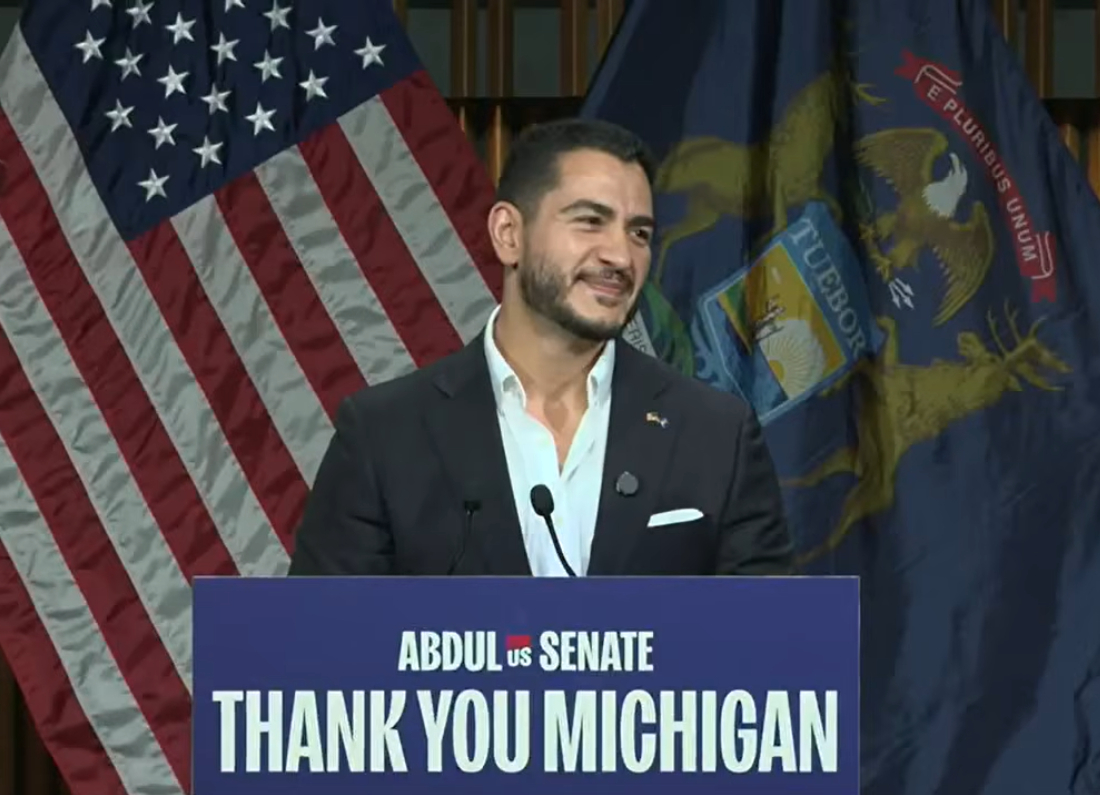
Donald Trump and JD Vance have received a spectacularly pointed response from the first Muslim elected to the United States Senate, after Democrat Abdul El-Sayed defeated the president’s preferred candidate in one of the most bitterly contested races of America’s midterm elections.
El-Sayed, 42, secured victory over former Republican congressman Mike Rogers in Michigan on Tuesday, marking a historic breakthrough for Muslim representation in American politics and a major success for the progressive wing of the Democratic Party.
But it was his victory speech in Detroit, delivered in the early hours of Wednesday 4 November, that quickly began attracting attention around the world.
Having spent months facing attacks over his religion, his name and his political beliefs, El-Sayed used the occasion to turn the tables on the two most powerful Republicans in the country.
He first addressed Vice-President JD Vance, joking about the prospect of Vance administering his oath of office when the newly elected Senate convenes in January.
Then he turned his attention to Trump, whose repeated mocking of his name had become a feature of the campaign.
“Donald, look, I know you struggle with my name,” El-Sayed began, before delivering the punchline.
“So after JD swears me in in January, you can just go on and call me Senator.”
The response was met with cheers from supporters, who had gathered to celebrate a victory that many in the Democratic establishment had once regarded as unlikely.
‘JD, habibi’: El-Sayed turns the tables on Vance
El-Sayed’s remarks about Vance were among the most memorable moments of his speech.
The vice-president had been one of the Republican figures who attacked him during the election campaign, with the contest increasingly focused on the Democratic candidate’s religion and political views.
Rather than avoiding that history, El-Sayed addressed Vance directly.
“JD, habibi, there is this delicious irony in the fact that you’re constitutionally obligated to swear me in in January.”
The Arabic term “habibi” is an affectionate form of address, commonly translated as “my dear” or “my beloved”.
In this context, it was delivered with unmistakable sarcasm.
El-Sayed followed the remark with another joke, declaring a victory for the Michigan Wolverines over the Ohio State Buckeyes, a reference to the fierce sporting rivalry between the two states.
Vance represented Ohio in the Senate before becoming vice-president, making the reference another carefully chosen dig.
There is a minor constitutional qualification to El-Sayed’s joke: although the vice-president traditionally administers the oath to incoming senators, the president pro tempore can perform that function in the vice-president’s absence. Vance is therefore not personally required by the Constitution to swear him in.
That technical distinction did little to diminish the political point.
Vance had helped campaign against El-Sayed, only to see him elected to the institution over which the vice-president presides.
And the incoming senator clearly intended to enjoy the irony.
Trump repeatedly targeted El-Sayed’s name and religion
The victory carried particular significance because of the manner in which Trump and other Republicans had campaigned against El-Sayed.
The president repeatedly drew attention to his Muslim identity and Egyptian family background, while making allegations about his political loyalties.
Trump suggested that El-Sayed had connections to Islamic extremism, including allegations about supposed Muslim Brotherhood associations.
El-Sayed denied those claims, and no evidence establishing the alleged extremist connections was presented.
Trump also mocked the candidate’s name, using variations of it during his attacks.
Vance described El-Sayed as “evil”, adding to a campaign in which the Democratic candidate’s religion had become a central political controversy.
Republicans defended their criticisms as legitimate scrutiny of his political positions, particularly his outspoken opposition to American military assistance to Israel and his support for progressive economic policies.
Democrats, however, accused the Republican campaign of exploiting anti-Muslim prejudice to undermine a candidate who had never previously held elected office.
El-Sayed’s response was to argue that ordinary voters were more concerned about the cost of living, healthcare and their children’s futures than the religion of a Senate candidate.
He repeated that argument in his victory speech, suggesting that Republican attacks on his identity had failed because they did not address the problems facing Michigan residents.
His message to voters was that arguments about his faith could not explain the price of groceries, fuel or medical treatment.
First Muslim elected to the United States Senate
El-Sayed’s election represents a historic milestone in American politics.
The son of Egyptian immigrants, he was born in Michigan and trained as a physician before building a career in public health.
He previously held senior public health roles in Detroit and Wayne County, developing a reputation for focusing on health inequality and the conditions affecting working-class communities.
His political career began with an unsuccessful attempt to win Michigan’s Democratic nomination for governor in 2018.
Eight years later, he returned to statewide politics with a campaign for the Senate seat being vacated by retiring Democrat Gary Peters.
The contest was far from straightforward.
El-Sayed faced an establishment-backed challenger in the Democratic primary and questions about whether a candidate openly advocating democratic socialist policies could win in a state that had supported Trump in previous presidential elections.
He defeated congresswoman Haley Stevens in the primary before facing Rogers, a former Republican congressman with extensive experience in national security politics.
The general election became a test of whether a candidate campaigning on universal healthcare, opposition to corporate influence and criticism of American foreign policy could win over a politically divided electorate.
El-Sayed’s victory means he will become the first Muslim to serve in the Senate when he takes office.
Muslim Americans have previously served in the House of Representatives, but none had been elected to the upper chamber.
A victory despite enormous political spending
The Michigan contest also attracted extraordinary levels of spending from political action committees and other outside organisations.
El-Sayed had made the influence of wealthy donors a central part of his campaign, arguing that America’s political system had become too dependent on corporate interests and billionaire-backed organisations.
His Democratic primary victory came despite substantial spending by groups opposing his candidacy.
The American Israel Public Affairs Committee, AIPAC, and aligned political organisations were particularly active during the primary contest, where El-Sayed’s criticism of Israel became a major point of contention.
The Associated Press reported that AIPAC spent nearly $30 million opposing his nomination.
Further spending from Republican and Democratic groups made the general election one of the most expensive Senate contests in the country.
El-Sayed used his victory speech to argue that his campaign had demonstrated the limits of political spending when voters were offered an agenda they believed addressed their concerns.
He accused special interests of trying to prevent him from reaching the Senate and promised to challenge their influence once in office.
That message formed part of a broader argument about removing money from politics and directing public resources towards ordinary Americans.
His position on Israel divided Democrats
El-Sayed’s campaign also exposed significant divisions within the Democratic Party over Israel and the war in Gaza.
He has been an outspoken critic of the Israeli government’s actions and has supported ending American military assistance to Israel.
His language on the conflict attracted criticism from some Jewish organisations and voters, while his supporters argued that opposition to Israeli military policy should not be equated with hostility towards Jewish people.
The controversy became particularly intense after his remarks following an attack on a Michigan synagogue and preschool earlier in the year.
El-Sayed was criticised for suggesting that people who experience suffering can sometimes inflict suffering on others, remarks which critics regarded as an inappropriate response to an antisemitic attack.
He subsequently apologised for the comments.
The dispute contributed to tensions within Michigan’s Democratic coalition.
His primary opponent, Haley Stevens, eventually endorsed Republican Mike Rogers shortly before the general election, an unusual move that demonstrated the depth of the disagreement.
Despite those divisions, El-Sayed secured enough support to win the statewide contest.
His campaign concentrated heavily on economic issues, particularly healthcare costs and the influence of wealthy donors, while maintaining his opposition to American military assistance to Israel.
During his victory speech, he again called for American tax revenues to be spent on domestic priorities rather than supporting military operations overseas.
The result adds to a disastrous midterm election for Trump
El-Sayed’s victory came during an extraordinary election night for the Democratic Party.
Voters delivered a major rebuke to Trump and the Republicans, with Democrats regaining control of both the House of Representatives and the Senate.
The party won a string of closely contested races and secured unexpected victories in Republican-held states, dealing a substantial blow to the president’s ability to push legislation through Congress during the remainder of his term.
Michigan was particularly important because Democrats needed to retain the seat being vacated by Gary Peters while attempting to overturn the Republican majority elsewhere.
El-Sayed’s victory ensured that one of the party’s most closely watched contests remained in Democratic hands.
It also provided encouragement to progressives who had argued that the party should offer voters a more ambitious economic programme rather than moving towards the political centre.
His success is not proof that the same approach would work in every state.
Michigan has its own electoral history, demographic composition and political concerns, while the Republican Party faced significant national headwinds during the midterms.
Nevertheless, the result is difficult to separate from the wider rejection of Trump’s administration.
A candidate the president repeatedly targeted over his identity has been elected to the Senate, while Democrats have regained control of Congress.
‘The bad guys lost’
El-Sayed also directed some of his sharpest remarks towards Rogers, the Republican candidate he had defeated.
The former congressman had received Trump’s endorsement and attempted to frame the Michigan contest as a choice between traditional American values and the Democratic candidate’s progressive agenda.
El-Sayed rejected that characterisation, accusing his opponents of relying on division rather than offering meaningful answers to voters’ economic concerns.
In his speech, he told supporters that the result demonstrated Michigan residents were capable of looking beyond religious and ethnic differences.
He also addressed families who had watched the president mock his name or question his faith, suggesting the election result provided a response to those attacks.
For El-Sayed, the victory was both a personal achievement and an opportunity to make a wider statement about who belongs in American political life.
He repeatedly thanked supporters who had opened their homes, churches and synagogues to his campaign, describing the coalition that elected him as a demonstration of the country’s diversity.
But he was not prepared to let the election pass without one final exchange with the Republican leaders who had spent months attacking him.
After teasing Vance about the Senate swearing-in ceremony, he returned to Trump’s repeated difficulties with his name.
The incoming senator offered a much simpler alternative.
From January, he suggested, the president would have only one title to remember: Senator.


Leave a Reply