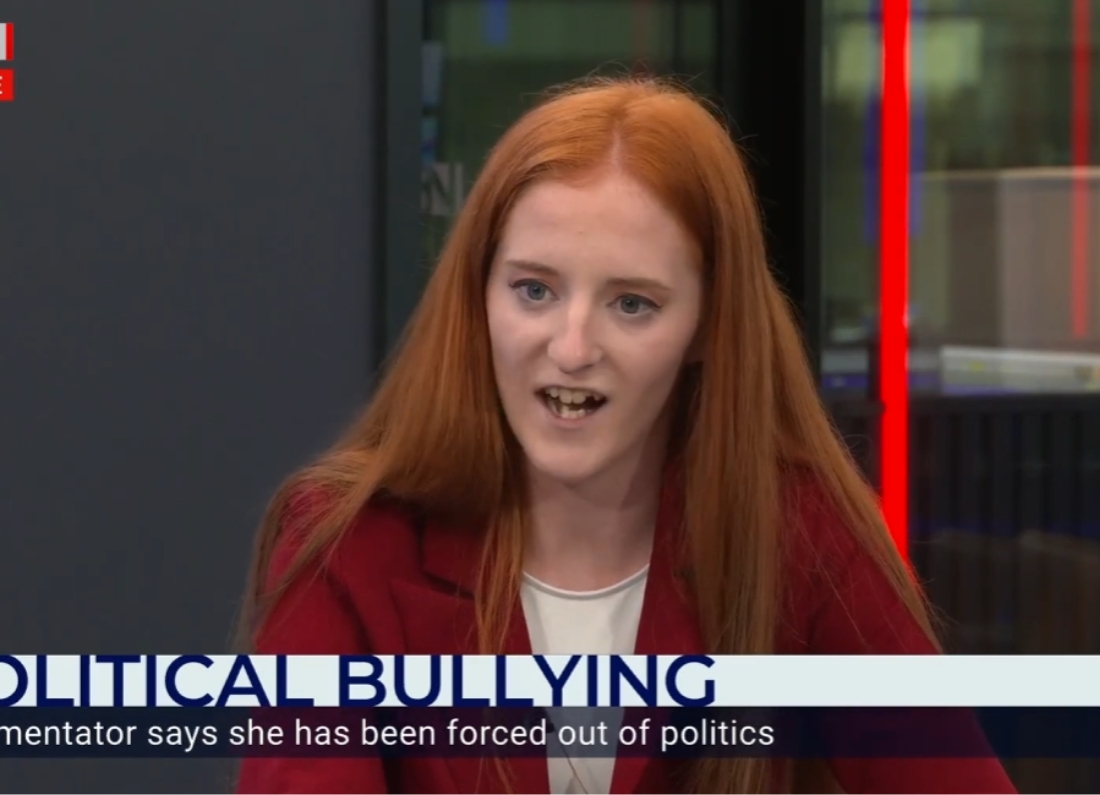
GB News commentator Sophie Corcoran is suing the 10,000 Interns Foundation under the Equality Act after being rejected from an internship scheme run in partnership with the Bar Council that is restricted to Black and minority ethnic applicants – in a case that legal experts warn could have a chilling effect on diversity programmes across British business and the voluntary sector.
The Guardian understands the charity has received a legal letter outlining Corcoran’s intent to sue. The suit claims she has faced loss of employment opportunity and discrimination on the basis of her being white, under the Equality Act 2010.
Corcoran, who presents on GB News and describes herself as having been “exploring a legal career,” applied to the scheme – which pays £14.80 an hour – and was rejected. She said: “This case is not simply about my own experience. I am pursuing it because I believe that no person in Britain should be denied opportunities because of the colour of their skin. I believe strongly that equality before the law must apply to everyone. Through this case, I hope to challenge practices that discriminate on racial grounds and to reinforce the principle that fairness and equal treatment should apply to all.”
What the 10,000 Interns Foundation is
The 10,000 Interns Foundation has been running since 2020 and placed its 10,000th intern last year. It is led by Rebecca Achieng Ajulu-Bushell – the former competitive swimmer who became the first Black woman to swim for Great Britain – and has placed paid interns with organisations including the Royal Academy of Arts, Bloomberg, HSBC and the NHS, which is taking 120 interns from the charity this summer.
Its model is built on what it describes as evidence-based positive action: using data about the under-representation of Black and minority ethnic people in specific sectors to target internship opportunities at those groups, with the aim of improving access to careers that have historically been largely closed to them.
Ajulu-Bushell responded to the lawsuit with a statement: “Talent is everywhere, but opportunity is not. That belief has guided our work from the beginning and remains unchanged. We are confident in the lawfulness of our approach. The aim of our programmes, training and mentoring is simple: to widen access, not limit it. I am incredibly proud of what we have achieved as an organisation in five short years, the lives we have changed and the workplaces that are thriving as a result.”
The legal question – is positive action lawful?
The Bar Council, which runs the specific scheme Corcoran applied to, has stated that it is “lawful positive action under sections 158 and 159 of the Equality Act based on evidence of under-representation in relation to access to the profession.”
Sections 158 and 159 of the Equality Act 2010 permit organisations to take proportionate steps to improve participation or reduce disadvantage for groups with protected characteristics – including race – provided the steps taken are a proportionate means of achieving that aim. The legal framework is specifically designed to allow targeted positive action of this kind.
Corcoran’s legal team will need to argue either that the scheme goes beyond what sections 158 and 159 permit, or that the evidence of under-representation does not justify the degree of exclusivity applied. The Bar Council’s position is that the evidence base is sufficient to justify the approach.
The American Bar Association faced a similar legal challenge in the United States and revised its schemes to require applicants to demonstrate “a strong commitment to advancing diversity, equity and inclusion” rather than specifying ethnicity. Companies in the UK are now concerned that similar copycat cases may begin to emerge following Corcoran’s action.
The political backing – and the language used
Corcoran’s challenge has been publicly backed by Rupert Lowe, the MP for Restore Britain – the party founded by the former Reform UK figure who was expelled from that party and now positions himself to its right on immigration. Lowe described the internship scheme as “vile, anti-white racism” and “racist filth.”
Elon Musk, who has long campaigned against diversity and inclusion initiatives in the United States and has previously backed Lowe – going so far as to claim that Restore Britain is “the only way to save Britain” – has not commented on this specific case.
The language used by Lowe is worth noting. Calling a scheme designed to help Black and minority ethnic people access the legal profession “racist filth” is not a characterisation shared by the legal experts, equality law practitioners or the organisations that have backed and participated in the scheme. It is language designed to generate heat rather than legal argument.
The chilling effect – and what is already happening
The consequences of the lawsuit may extend well beyond whether Corcoran wins or loses.
Dr Shabna Begum, chief executive of the Runnymede Trust, said: “Attacks of this nature risk creating a chilling effect. Even when claims lack strong legal grounding, their visibility can deter organisations from pursuing EDI initiatives for fear of reputational or legal consequences. And it is not just the individuals who lose out on internships that suffer. There is considerable evidence that EDI policies, when implemented thoughtfully and systemically, actually improve productivity, performance and financial returns for the organisations that undertake them.”
That chilling effect is already visible. Other organisations told the Guardian they had amended their positive action internship schemes specifically to avoid similar legal action – removing mention of ethnicity from titles and limiting the length of internships. The legal letter alone, even before any court ruling, has begun to reshape behaviour.
There is also concern within the 10,000 Interns Foundation itself that the lawsuit could threaten its future. After right-wing campaigns last year, some organisations withdrew their support from the scheme. The combination of reputational pressure and legal threat has forced the charity onto the defensive at precisely the moment it has reached its 10,000th placement.
Why this case matters beyond the headline
The 10,000 Interns Foundation is one of a range of organisations that have spent years attempting to address documented structural inequalities in access to prestigious careers in law, finance, media and the arts. The evidence of under-representation in these sectors is not disputed – it is the basis on which the Equality Act’s positive action provisions were designed.
The argument that treating members of under-represented groups differently in order to reduce that under-representation constitutes unlawful discrimination against members of majority groups is a legal argument that has been tested in multiple jurisdictions. In most European contexts, proportionate positive action designed to address documented disadvantage has been found to be lawful. Whether Corcoran’s case succeeds in the British courts depends on whether the specific design of the Bar Council scheme falls within the proportionality test the Equality Act requires.
What is not in doubt is the political context in which the case is being brought – or the effect that publicity around it is already having on the organisations that have spent years trying to open up professions that remain significantly less diverse than the population they serve.
You may also like: Farage faces parliamentary standards probe after £5m personal gift from crypto billionaire revealed